
Sicily Travel Blog Preview
Travel guide including history, culture,
Caravaggio & photos
See the Sicily Photo Gallery here,
including Palermo, Mount Etna,
Stromboli & La Valle dei Templi
The island of Sicily lies at the foot of Italy, like a ball ready to be kicked. Its ancient name is Trinacria from the Greek Τρινακρία, which means “having three headlands”, although the modern name derives from an Iron Age tribe called the Sicels. This mountainous land, separated from Italy by the Strait of Messina, less than two miles wide, is the most populous island in the Mediterranean with about five million inhabitants. However, waves of emigration over the past century as a result of endemic poverty have meant that today around ten million people of Sicilian descent live scattered around the world.
The island is notable for being the sometime residence of that thuggish genius Caravaggio, for the ravages of drought (48.8°C was recorded in 2021), its 1000-year history of ice-cream making, and for Mount Etna, the icon of Sicily, at 3,323m the tallest active volcano in Europe. (The island is situated at the northern edge of the African Plate, which explains its fiery heart.)
Its central location on trading routes between Europe, Africa and the Middle East, has given rise to a long and rich history stretching back 16,000 years, but has also resulted in it being one of the most invaded places on the planet. Unwelcome guests have included the Greeks, Romans, Phoenicians, Normans, Ostrogoths and the Vandals themselves. Unusually for them the invasion by the Americans and British was actually a welcome one, liberating the island from the Nazis.
The Norman invasion led to the establishment of the Kingdom of Sicily which lasted almost seven hundred years (1130-1816), although during this time the baton passed between Aragon, Spain, Savoy and then the Hapsburgs. The island finally became part of Italy in 1860 following the invasion of Giuseppe Garibaldi.
Sicily is well known for being the home of the mafia. The Cosa Nostra (“our thing”) first emerged in the 18th century, hired by the wealthy as protection against roaming brigands, and is still going strong today. Its tentacles reach as far as America. “Off they go, through the streets of Passo di Rigano, Boccadifalco, Torretta and at the same time, Brooklyn, Staten Island and New Jersey. Because from Sicily to the US, the old mafia has returned" (La Repubblica). The mafia's most distinguished victims are respectfully named cadaveri eccellenti (“excellent corpses”).
©wonderfulworldblogs.com
Palermo
Palermo, on the north-west coast, was founded by the Phoenicians in 734 BC (making it 780 years older than London). It is now the island’s cultural, industrial and commercial capital, with a population of 1.3 million.
Stepping off the plane the horizon is dominated by soaring cliffs like castle battlements piercing the crisp, icy air (reminding me of the view of the Himalayas at Kathmandu airport). The atmosphere in the small terminal was relaxed, aided by the sound of Frank Sinatra crooning Christmas favourites.
Down tree-lined boulevards the modern tower blocks of the suburbs give way to the ageing apartments of downtown, from whose balconies washing hangs, even in winter. The city centre is situated on rising ground above a busy port, dominated by characterless ships many stories high. It is punctuated by two opera houses and a multitude of old churches. The way of life seems relaxed - the bikers probably wouldn't run you over like Roman ones might.
Down a narrow street with worn cobblestones the air was thick with the smoke of cigarettes and barbecues, and people twisting to the riotous sound of pop. Turning a corner, the huge, ornate towers of a 12th century Norman cathedral rose up from a square lined by vertiginous palms and an excavated pavement of mosaics of fish and turtles from Roman times.
On one side of the cavernous interior there is an innocuous doorway by a strangely unimpressive group of royal tombs. Climbing up a narrow circular stairway you emerge in the cool air and are rewarded by a spectacular panorama of the roofs of the old town framed by mountains and the dark blue sea. On Christmas Day I attended the missa at the cathedral, packed with penitenti standing reverently for long periods while cantors intoned, priests rabbited on and the choir sang familiar carols. Even the statues bowed their heads respectfully.
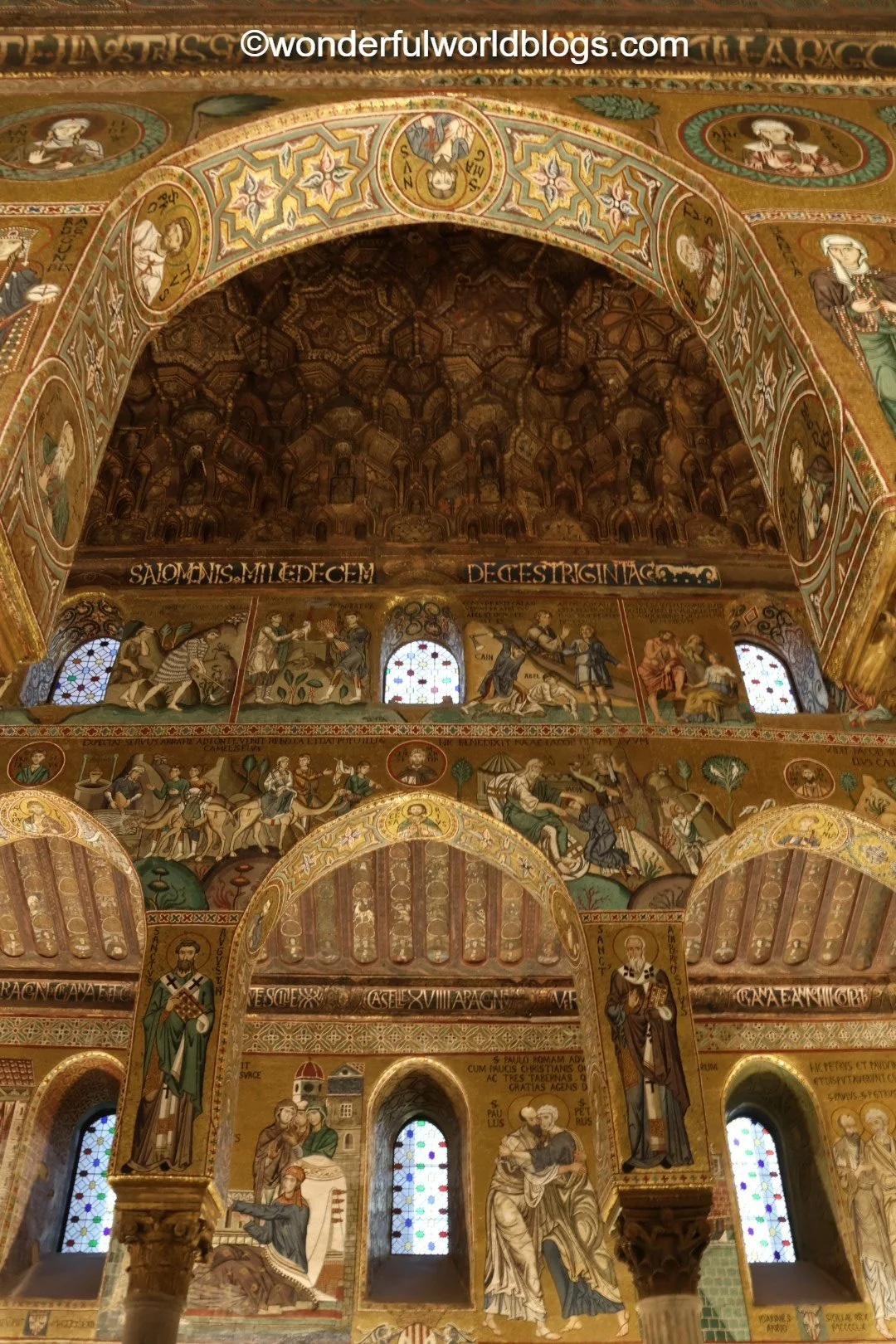
Up the street from the duomo are the imposing walls of the Palazzo Reale, built by the Saracens in the 9th century as a residence for kings, and now, with airport-style security, hosting the regional parliament. Through a grand courtyard you enter the Cappella Palatina dating from 1143, its slender columns leading the eye up to a great height relative to the chapel's size. Every inch of the barrelled ceiling is adorned with intricate Christian mosaics and golden Islamic figuration sufficient, perhaps, to impress even the royals who once worshipped there. In the palace's exhibition space pottery by Picasso looked strikingly similar to objects discovered amongst the city's 4th century BC walls.
Cefalù
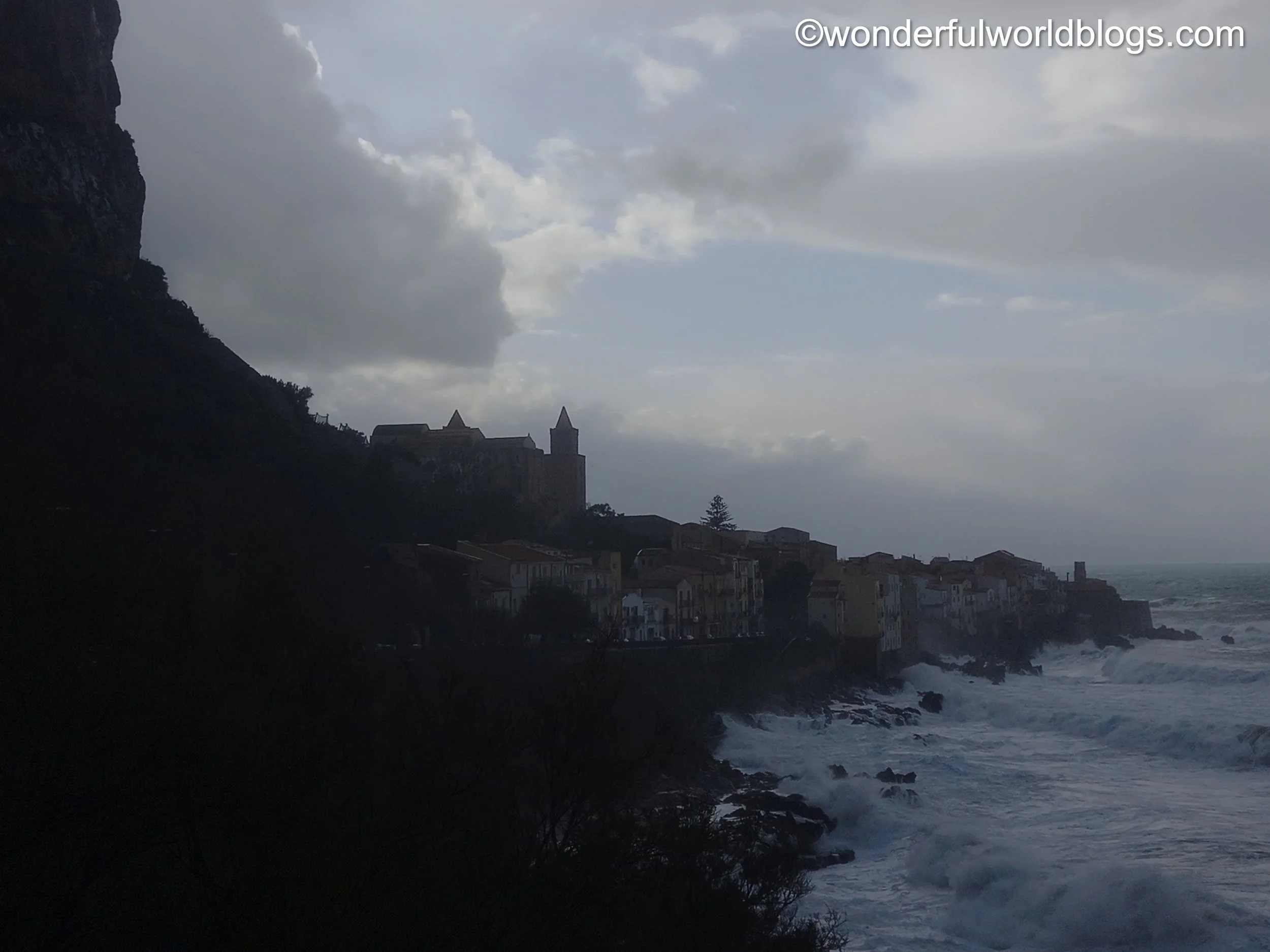
From Palermo there are a few trains a day east along the Tyrrhenian coast to the small town of Cefalù. Along the wave-battered coast with its backdrop of brooding mountains, their heads lost in the clouds, are crumbling watch-towers guarding from enemies long-since departed. Its bohemian lanes leading up from the harbour and medieval laundrette are overshadowed by the scale of its cathedral, and its backdrop La Rocca, a sheer, 270 metre cliff face.
The cathedral was founded in 1131 by Roger II, supposedly in gratitude for the survival of his ship from one of the umbrella-destroying storms that still beat down mercilessly today. Taking shelter in the quiet wooden pews below the immense height of the nave I gazed upward at the huge figures of the holy story, depicted vividly in medieval mosaics. They looked back at me humanely, bathed in a soft yellow evening light.
Monreale
At the head of a broad valley above Palermo is the hill town of Monreale. In its mighty duomo there are further mosaics, including a twenty-metre-high Christ. Despite its immense size the cathedral was completed in only a decade (a feat that would test even modern builders), resulting in a glorious harmony in its design. Each of the 120 columns of the cloisters next door is carved with scenes from the bible, telling their story as clearly now as they would have done to medieval monks doing their daily rounds.

Caravaggio
Down a gloomy alleyway off a quiet cobbled street in the old quarter of Palermo is an unusually tall doorway. Climbing a few steps you enter a small courtyard where a bust of a bewigged gentleman peers out from beneath twin orange trees. The Oratorio di San Lorenzo was built in the 17th century, but by the second half of the 20th the building had been a family residence for years. One stormy night in 1969 someone picked the lock on the door to the chapel and rudely cut Caravaggio’s Nativity from its frame.
Enjoyed the preview? Instantly download beautifully designed PDFs, including the complete Sicily blog and more destinations, in the Shop. Includes Stromboli, Taormina, Catania, Mount Etna, Siracusa, Agrigento, La Valle dei Templi and Le Catacombe dei Cappuccini.
Lorem ipsum dolor sit amet, consectetur adipiscing elit. Vestibulum id ligula porta felis euismod semper.