
Greenland Travel Blog
(full blog free)
Travel guide including history,
politics (Greenland & America)
& wintry photos
Skip to Nuuk, Narsarsuaq, Qaqortoq,
Nanortalik, Qassiarsuk & Eric the Red, Ilulissat,
Greenland & America, Greenland & Denmark
See the Greenland Photo Gallery here,
including icebergs, Nuuk, South Greenland
& Eric the Red’s home
Greenland is the largest non-continental island in the world, more than nine times the size of the UK. Eighty per cent of her surface is covered by a vast ice sheet, the greatest outside of Antarctica. It was first crossed in 1888 by the Norwegian Fridtjof Wedel-Jarlsberg Nansen and his companions, who navigated ice cliffs and crevasses and endured temperatures of minus 40°C, inside their tents. The lowest temperature ever recorded in the Northern Hemisphere was in Greenland: minus 69.6°C.
Eighty per cent of the country lies above the Arctic Circle and its northernmost point is only 740 kilometres from the North Pole. Some settlements rely on just two supply ships per year and the sea ice can stretch further than a dog sled can travel in a day. For thousands of years the village of Etah was a crossing point for Inuit arriving from Canada. Once the most northerly inhabited place in the world, it is now home only to polar bears. In Qaanaaq the inhabitants gather on a hill outside town every February to celebrate the return of the sun after four long month's absence.
In the dominant tongue Kalaallisut the country's name is Kalaallit Nunaat, which means "Land of the Kalaallit." Legend has it that the Viking Eric the Red (due to the colour of his hair, not because of his political allegiance or loyalty to a particular football team) coined the name Greenland to make it sound more appealing to future settlers, which would have been a remarkable demonstration of foresight. Or perhaps the southern shores on which he alighted shone green with the melting of the snow.
With only 57,000 people Greenland is the least densely populated country in the world. Not surprisingly ninety per cent live on the coast, mostly towards the south and west, where the climate is more bearable and the location more favourable for trade. The rest remains one of the world's great wildernesses.
The vast majority of the inhabitants are Inuit (which means "people" in the Inuktitut language), who came from Canada and northern Alaska. (Eskimo on the other hand, are a different ethnic group altogether, who originated in Alaska and, before that, Siberia. It is best not to use the term Eskimo in Greenland, unless you wish to be kicked out of the bar in sub-zero temperatures.)
The traditional religion is animist: the belief that everything, whether snowflake, mighty whale, or bird in the sky has a spirit. While few practise the religion now - most being Christian - its credo is still at the core of their culture.
Traditionally the Inuit lived a semi-nomadic lifestyle, stopping a while if the hunting was good, or to bury their dead under rocks, as the icy ground was too hard to dig. Nothing was wasted, everything had to be carried, so their art focused on decorating tents, tools and clothing with images of the animals and fish they consumed. (One of the most incredible exhibitions I ever saw was of Ice Age art, objects that connected us to the thoughts and feelings of our ancestors, art that would be familiar to the Inuit.)
Singing, dancing and drumming are popular in traditional culture. Song duels, that might incorporate wrestling or face slapping, were used as a way of resolving conflict.
Understandably the Greenlanders have many words for snow and ice - fifty in fact. The longest word in their language is "nalunaarasuartaatilioqateeraliorfinnialikkersaatiginialikkersaatilillaranatagoorunaresuarrooq" (apologies for any typos). For those of you who are not fluent in Kalaallisut, this means "again they tried to build a radio station but it appears that it is actually still only on the drawing board," which must be the longest moan in the world.
History
About 4,500 years ago people crossed the narrow straight from Canada to hunt reindeer and musk oxen. In the absence of trees they used driftwood, animal skins and bones to construct rough but effective shelters. Over time they learnt to extract oil from whales, seals and narwhals (“the unicorns of the sea”) to provide light and heat. They lived in a place where a succession of European explorers were to die. Just one of these peoples - the Saqqaq - survived in this most inhospitable of places for 1,800 years. So inhospitable in fact that from roughly the 1st to the 7th century AD Greenland was uninhabited.
In c982 the hot-headed Viking Eric the Red, escaping from a series of violent confrontations in Iceland and elsewhere, landed on the southern shores, establishing a Scandinavian presence that continues to this day. His son, Leif Erikson, was equally as adventurous. It is believed that he discovered Vinland (modern day Newfoundland) in around 1000 AD, thereby becoming the first European to set foot in the Americas, nearly five hundred years before Colombus.
During the subsequent centuries Greenland changed hands between the Norwegians and Danes, or was shared between them, until in 1814 Denmark took over permanently. Even though the Greenlanders were made Danish citizens in 1953 it was not until 1979, almost a millennium after the first Europeans arrived, that they were finally given a say in their own land. (There is a dichotomy here, but also a dilemma: although 98% of Danish territory lies in Greenland, only 2% of her citizens live there. How should they be represented?)
Denmark provided access to European-style education and healthcare but her policy of cultural assimilation, even when well-intentioned, mostly resulted in a degradation of indigenous culture. Inuit were encouraged to settle in Nuuk, now the capital, necessitating a profound change in their lifestyle. Many ended up in very different housing than they were used to, whether in the now ubiquitous multi-coloured huts or in tower blocks. It was reckoned that Block P in Nuuk housed 1% of the entire population. In addition the government promoted the exclusive use of Danish in official matters, and required Greenlanders to go to Denmark if they wished to pursue university level education. Many children ended up in boarding schools in Denmark, which frayed their ties to their motherland. A ray of hope was the founding of the University of Greenland in 1987, which provided the Inuit with higher education in their own language and country.
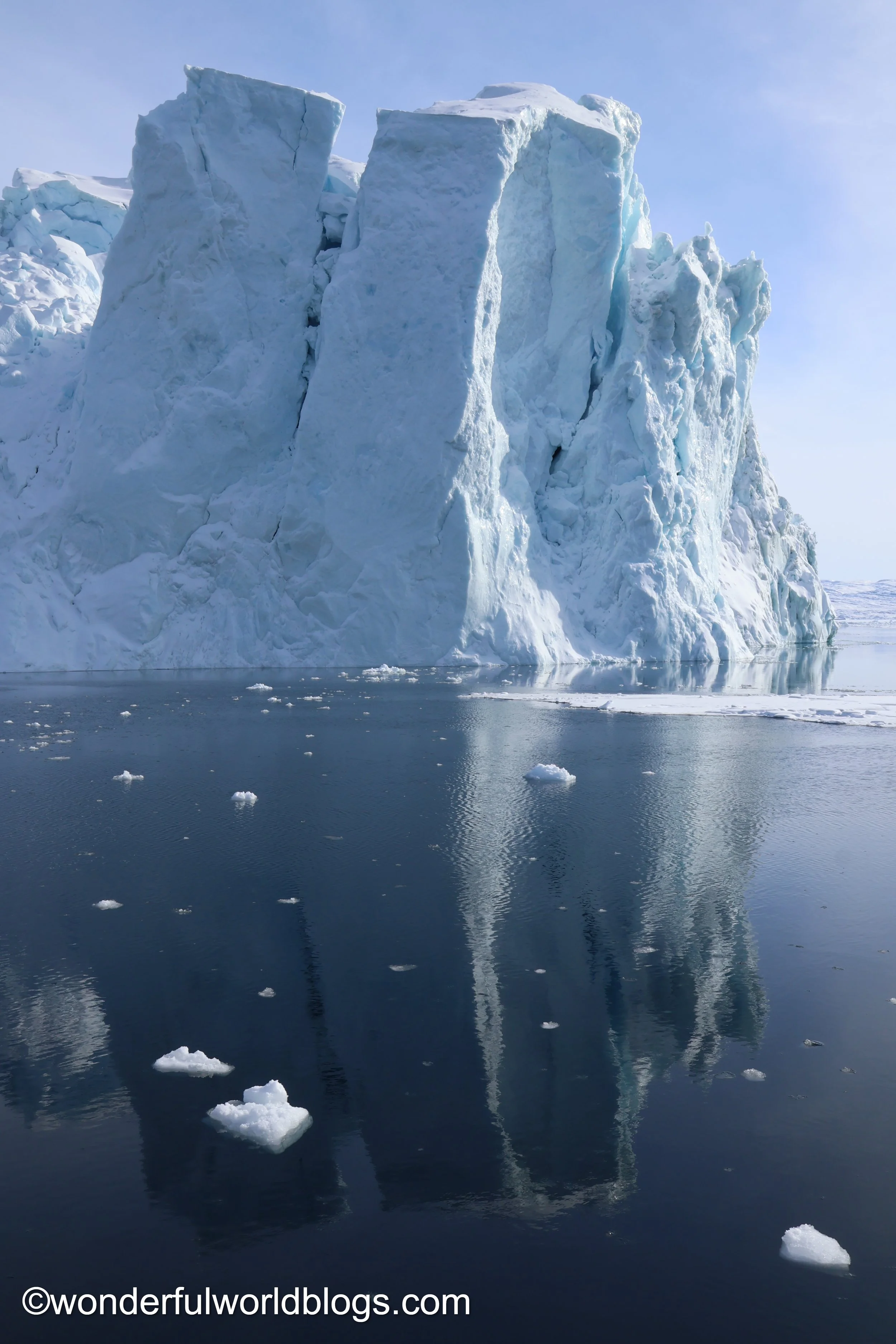
In 1909 in the Ilulissat fjord, roughly halfway up the west coast, a very large iceberg about 1.5 kilometres in length calved from the Sermeq Kujalleq Glacier and drifted out to sea. Three years later it is reckoned it measured only about 100 metres long and 25 high. We know this because on Friday the 12th of April 1912 it was seen by the SS Etonian, which was sufficiently impressed to take a photograph. Two days later, at thirty minutes to midnight, this most famous of icebergs was spotted by Frederick Fleet, the lookout in the crow's nest high above the meticulously polished decks of the RMS Titanic.
©wonderfulworldblogs.com
Green men & women
Snow lay upon the black volcanic earth and the streets were full of green men and women, celebrating St Patrick's Day in Reykjavik. From the tall spire of Hallgrim's Church bohemian shops and ugly tower blocks line the streets down to the fjord, its dark waters reflected in the glass walls of the modern concert hall. Most of the Icelanders I spoke to had no interest in visiting Greenland, preferring to holiday in warmer climes. They are sympathetic to the idea of her independence from Denmark though, having secured their own freedom a century ago after over five hundred years under her yoke.
There & back again
A two hour delay due to bad weather in Greenland stretched to five, and then to seven before we finally took off. After two hours' flight preparations were being made for landing in Nuuk and excitement was building in the cabin. Then a brief announcement: "The runway is closed due to heavy snow. As a result we have had to abort the landing and will be heading back to Iceland." We had gotten so close that people on the ground had heard our plane approaching. Arriving back in Iceland the flight attendant had the temerity to announce: "Welcome to Iceland. We hope you enjoyed your flight and hope to see you again soon."
Put up in a hotel I had the opportunity to meet some of the other passengers. An Inuit fisherman returning from a voyage, and an Inuit lady resident in Denmark. Danes working at the university in Nuuk, and one on active service with the military. An American big-game hunter who boasted of having killed a lion and an elephant, and a group of Puerto Ricans on a mission.
Third time lucky?
White, everything white, apart from streaks of grey rock briefly appearing through the clouds. After two hours' flight our hopes began to rise as we commenced the descent. Then, disconcertingly, the plane began to climb. The captain announced: "Our approach has been aborted due to reduced visibility." Not again! But this time we would circle around and give it another shot.
Above the clouds the sun shone brightly through the blue skies, then we lost visibility again as we descended. Tension rising, a fjord came into view, then, all of a sudden, the ground. We came down fast and landed with a bump, engines screeching into reverse. "Welcome to Nuuk." Cheers erupted from the cabin, as much from relief as anything else. The adventure had already started and I had only just arrived.
Nuuk
Nuuk is the most northerly capital in the world. In Greenlandic its name means "tip", the city standing on a promontory at the head of a huge fjord system stretching 170 kilometres inland from the Labrador Sea to the great ice sheet.
The region was home to the Saqqaq people as far back as 2200 BC, but the modern city was founded in 1728 by the Danish-Norwegian missionary Hans Egede. He named it Godthåb, meaning "Good Hope," a name it kept until 1979. Nuuk is the fastest growing settlement in the country with a third of the population living there. Despite the Danes, Asians and occasional Mancunian resident "it may well be the most indigenous city in the world" (Guardian, 2016), with 90% of the people being Inuit.
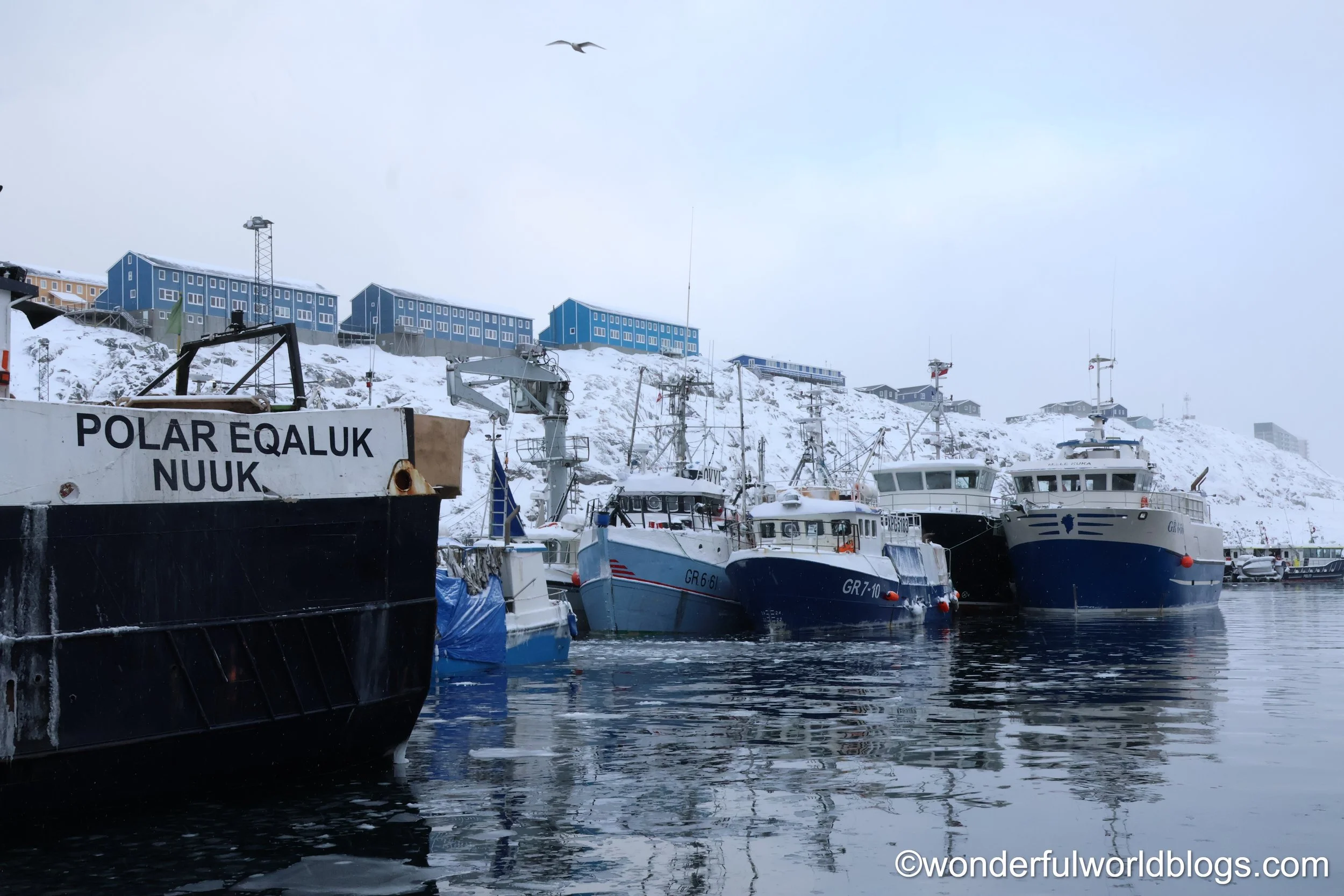
Multi-coloured houses scattered across the low hills struggled to enliven the sight of dull apartment blocks and glamourless industrial complexes, below a sky of impenetrable grey. The port was packed with brightly-lit, snow-covered vessels, but the few people I spotted disappeared around a corner when I approached. The smell of fish emanated from factory doors. In the centre the supermarket was stocked with long-life food and a few old fruit (most things are flown or shipped in). But the lady at the checkout, an Inuit on a bicycle and the punters in the main bar, Daddy's, were friendly. For a walk home in -20°C multiple fleeces and a balaclava were essential, crampons and gloves that allow you to use your phone without getting frostbite invaluable.
©wonderfulworldblogs.com

Kangerlua (Nuuk Fjord)
As I set off early the next morning the rush hour was in full swing, aided by a team of hard-working snow ploughs. (Drivers here rarely have to wait at a red light - there are only three in the whole country.)
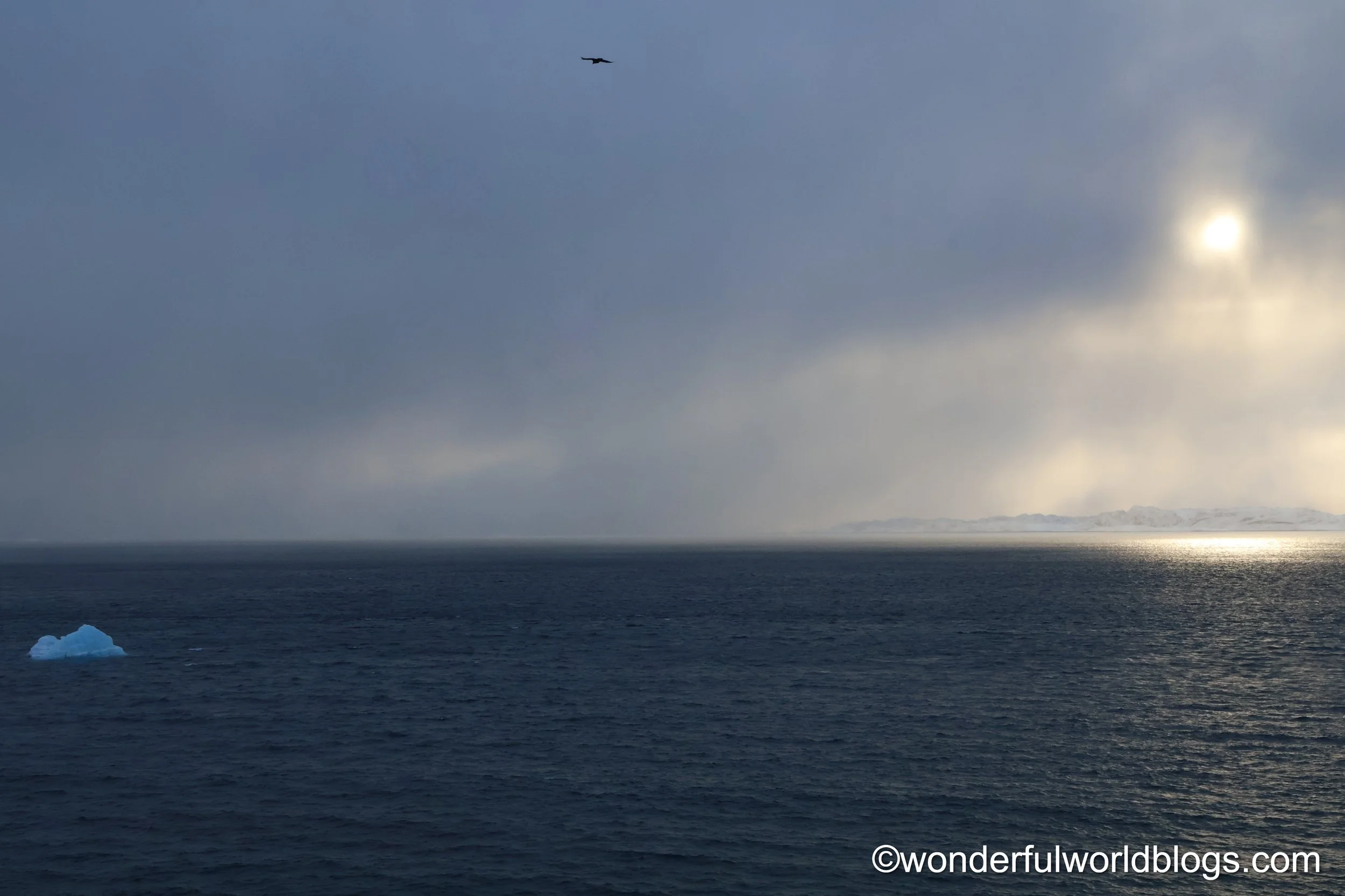
The boat pulled out from the harbour past the Polar Explorer, Royal Artic Line and Ocean Endeavour. Within a few minutes the lines of houses petered out leaving only birds and small icebergs for company.
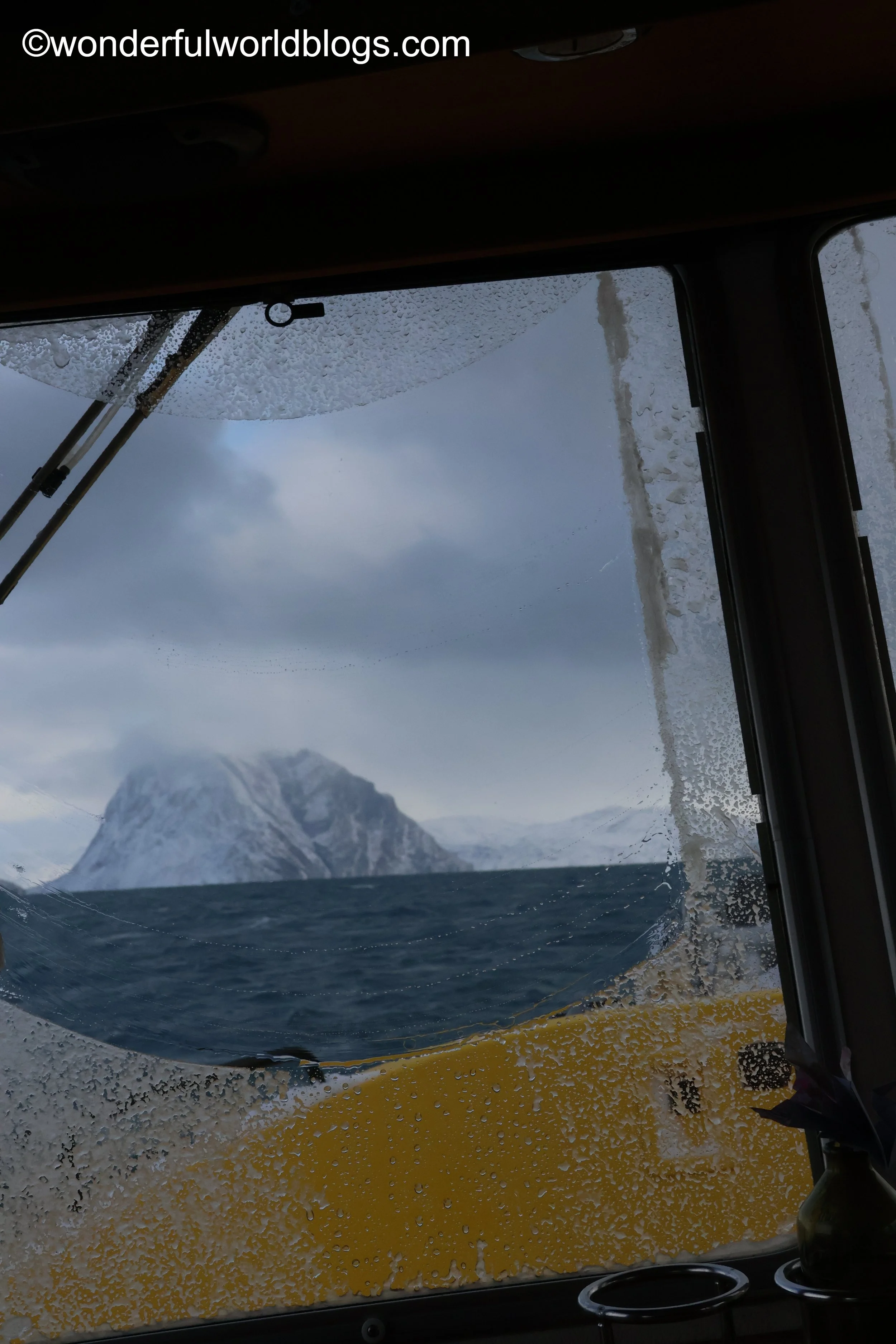
Precipitous mountains line the blue-grey waters of Kangerlua, the second largest network of fjords in the world. (The largest is Scoresby Sound on the east coast.) The waters are fed by three glaciers. But, as the Greenlandic-Danish captain told me, the ice is in retreat. A glacier that fifty years ago reached all the way from the fjord to the 1,216 metre summit of Sermitsiaq may disappear in the next twenty. While February temperatures used to be as low as -32°C, now they might only be zero. Snowmobiles that were once used continuously now often remain in the garage.
Global warming also causes more icebergs to calve. In the last few years so many have littered Nuuk Fjord that at times people have been unable to take their boats out. Icebergs come in three colours: white (5,000 to 8,000 years old), blue (the most beautiful, up to 10,000), and black (10,000+). According to an Inuit lady I spoke to black ice tastes best with your whisky.
Sailing into a thin sheet of sea-ice while reindeer ran in the hills above, we put down a fishing line and within minutes had pulled up half-a-dozen thrashing cod.
The fjord is home to millions of birds, but very few people. Kappisillit, meaning "salmon", is the sole settlement. In the shadow of Pingu Mountain the population have traditionally survived off hunting and fishing. In the 1990s there were 180 residents. Now, with just forty remaining, there are only a handful of children in the school and the church pews could accommodate the whole population several times over.

Narsarsuaq
The tiny plane was airborne within seconds and the dozen or so passengers and I were on our way to South Greenland. Imagine your neighbour doing some heavy-duty DIY and you get some idea of the racket and vibrations caused by the propellers. The stewardess (there was only one) brought each of us a cup of tea and a biscuit. She wore boots made of sealskin.
The ocean was covered in ice and as the plane descended the fjord glistened in the sun.
Narsarsuaq Airport - 'Bluie West One' - was built in 1941. Bluie was the Allied codename for Greenland. The airport provided an invaluable stopping off point for thousands of planes crossing the Atlantic bound for the battlefields of Europe. The original terminal still survives, made of corrugated iron. Up the valley there used to be a large hospital, built to care for returning casualties. Injured, in pain, maimed perhaps, but alive, which the young dead would have taken any day.
Five minutes' walk from the airport, down the only road, is a large modern hotel. These two places provide most of the employment in the town, population 140. (I met a Filipino lady at the hotel, working there with several siblings. She had come from 45°C in her own country to work in East Greenland, where temperatures can plummet to minus 45°C.)
In the bar I met an American called Mike Bradford. He worked as a ferry pilot, flying light aircraft across the Atlantic when the cost of shipping a fixed-wing plane would be prohibitive. He knew most people in his profession and was pretty sure that he had completed more transatlantic ferry crossings than anyone else: more than five hundred. When the weather was unfavourable he would hit the bar at Narsarsuaq Hotel and sink a few beers.
But the airport's time is coming to a close. Within weeks, after more than eighty years of use and of tall tales being told, it will be closing, along with the hotel, and a new airport opened down the fjord in Qaqortoq.
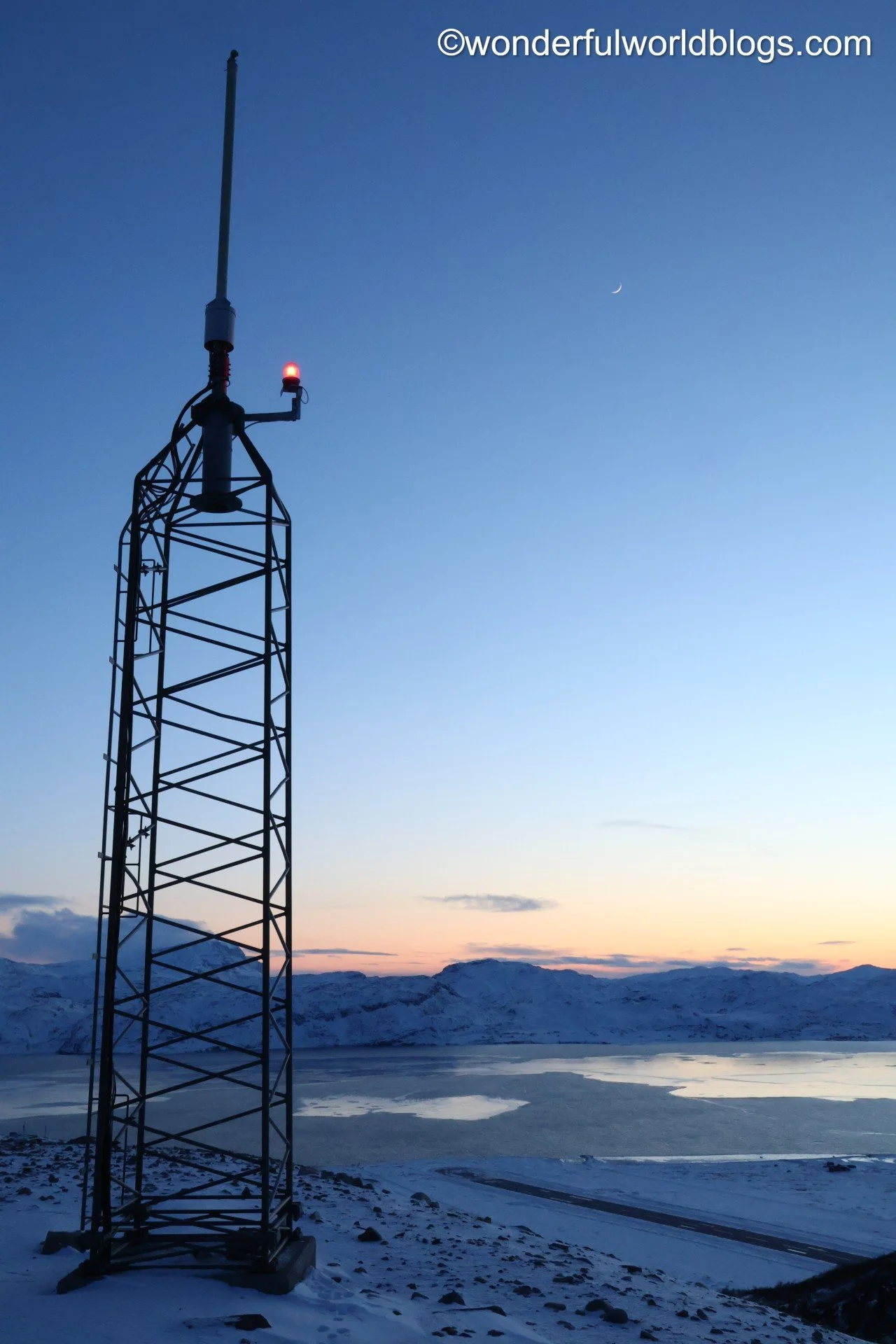
High above the town stands Signal Hill. Near her summit is a concrete building: a signal station. The fruit of much labour it is now defaced by rusted, twisted metal and open to the wind. It once connected this far-off place to the troubles of the world, which some would wish of this land once more.
©wonderfulworldblogs.com
Narsaq
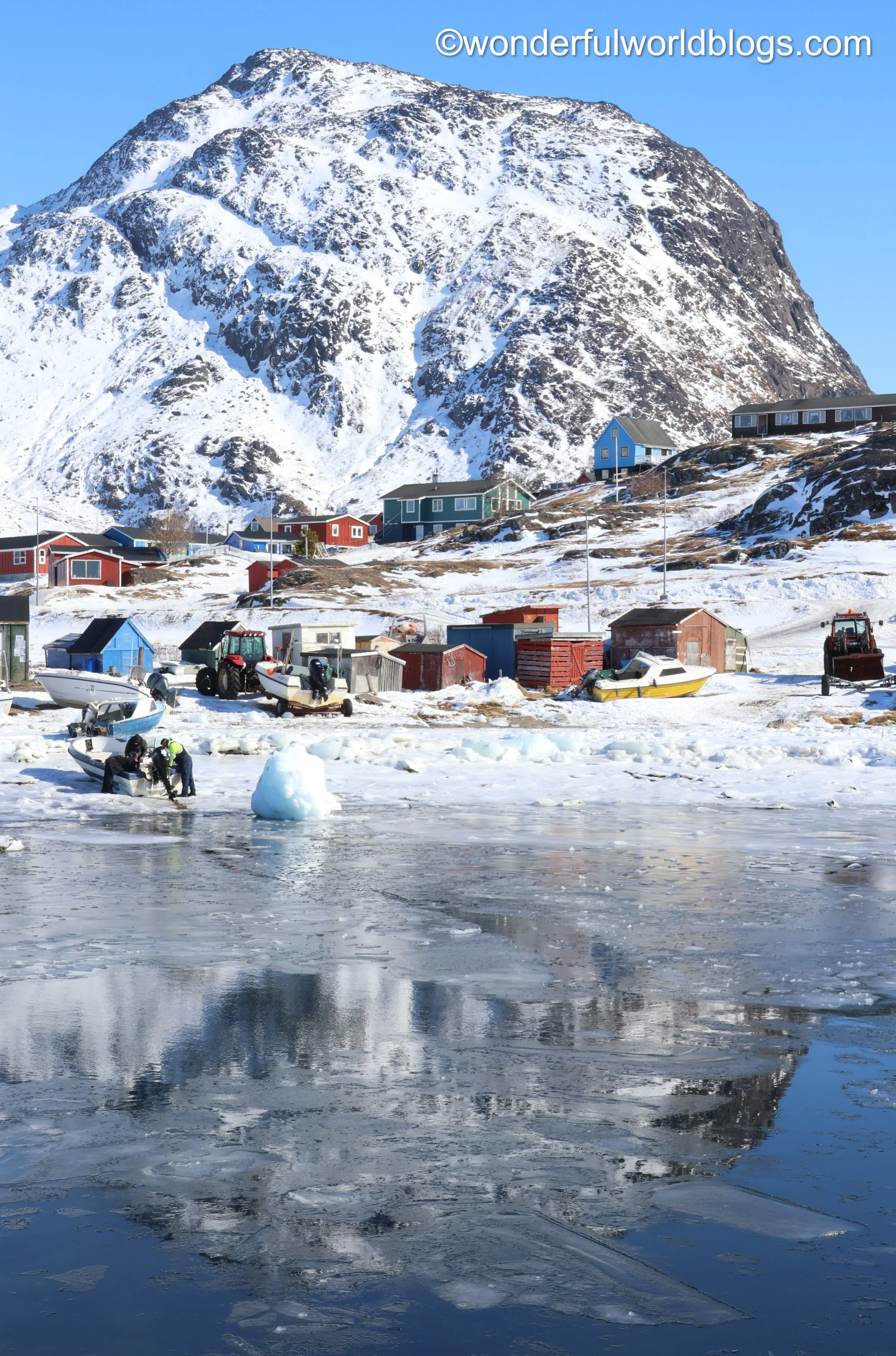
An hour down the fjord from Narsarsuaq, below the soaring face of Qaqqarsuaq Mountain, is Narsaq. The population may only number 1,200, but it is Greenland's ninth largest town. Beyond the ugly port colourful houses spread up the hillside. The Norse were here a thousand years ago. In more recent times people lived off seal trading, fishing and livestock farming. But what puts the place on the map nowadays are the mines in the hills above, where uranium and rare earth minerals are extracted.
The museum may have been closed but I stumbled across a reindeer antler workshop run by Enok. Harder than wood the Inuit had many uses for the bones, from tent poles to harpoons. When drilled the smell is nauseating, though not as bad as that emitted from a pair of musk ox hooves (even Enok had to hang those up outside). He spoke to me about his life, football and of Danish exploitation of his home. He sang me an exuberant hunting song from the east, accompanying himself on a drum, and showed me pictures of this green land in summer.
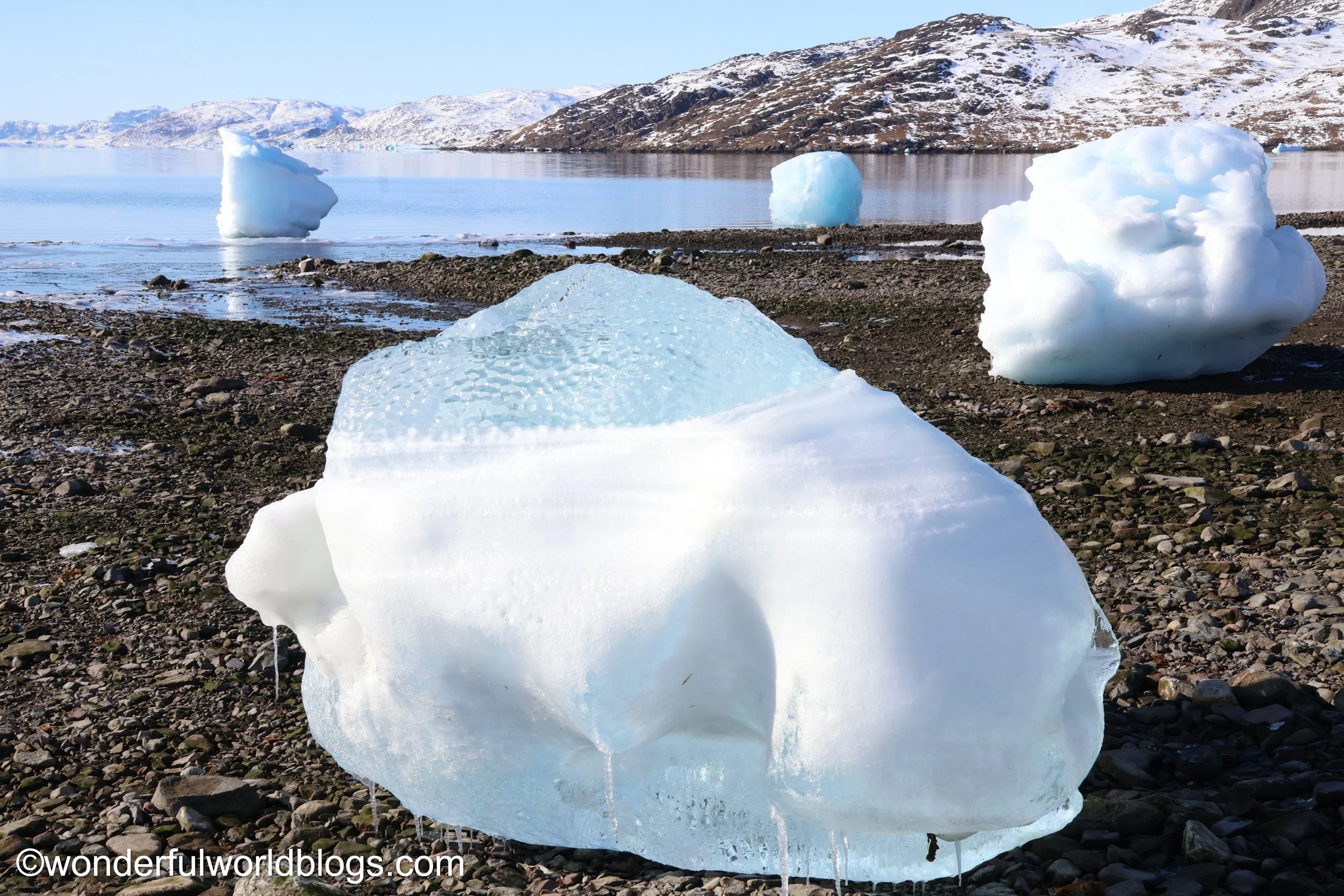
Walking towards the hamlet of Dyrnæs icebergs littered the fjord like ships at anchor. Some lay on the rocky shore like beached whales. I gave one a whack with a rock. It was hard enough to sink the Titanic.
Qaqortoq
Slaloming through the icebergs the ferry pulled into Qaqortoq. Home to the Inuit for 4,000 years and the Norse for five hundred, today it has 3,000 inhabitants, an incredible 50% of South Greenland's entire population. Nevertheless, for those who worry about being swamped by foreigners, this figure is dwarfed by the 30,000 tourists that visit annually, mainly on cruise ships. In just one day three ships disgorged 6,000 people, no doubt with barely a word of Kalaallisut between them. The harbour once provided a berth for whaling ships (I spotted a rusting harpoon gun on the quayside) and is now the starting point for the Artic Umiaq Ferry's journey to Ilulissat, halfway up the west coast, four days' sail away.
The small museum contains sleekly-designed kayaks, an anorak made from the gut of a bearded seal, and a walrus skull with two giant teeth which one tourist mistook for a sabre-toothed tiger. Tupilak (small gargoyle-like charms made of bone) were used in Pre-Inuit worship of the bear, and bestowed on the bearer strength and protection. A blubber bag stored fermented blubber and oil for consumption for up to two years. (Nowadays, understandably, the Inuit prefer pizza). Bedrooms in the museum's attic once hosted Knud Rasmussen, explorer and father of Eskimology, and Charles Lindbergh, the first person to fly non-stop across the Atlantic (the so-called "Lindy Hop", after which the original type of swing dance may be named).
I took a walk beside a frozen lake, past abandoned shipping containers and old cars salvaged for parts, until a dark blue fjord came into view over the crest of a hill. There I saw the first patches of green land since I had arrived.
©wonderfulworldblogs.com

Nanortalik (The place where polar bears go)
It appeared like a bumblebee at first. Then quickly grew bigger and BIGGER...until it disappeared on the helipad in a cloud of white. "It's my first time in a helicopter," I told the pilot. "Mine too," he joked. A few flicks on the control panel and the blades started up again, slowly at first, then faster and faster until they were lost in a blur. We lifted off, unsteadily, like a newborn foal. Then straight up hovercraft-like, the noise drowning out the screams of a baby (his first time too). Then, tipping the nose, we were away over the grey and white mountains and fjords scattered with icebergs. Forty minutes later, passing through a narrow gully, a collection of low-rise buildings appeared on the only patch of flat ground for miles around.
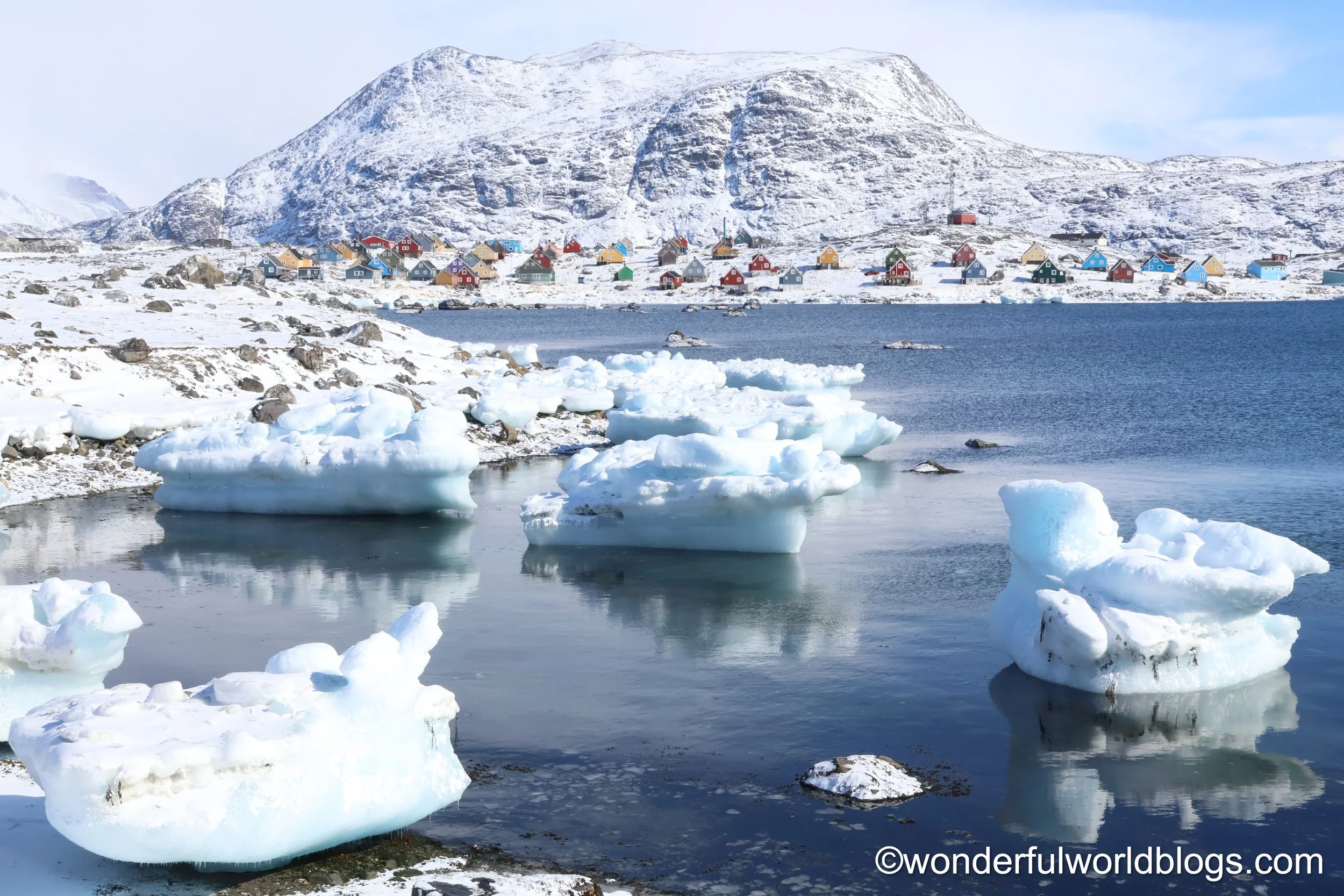
Nanortalik means "the place where polar bears go." Several are spotted each year, usually floating by on icebergs from which they hunt. Sometimes they venture into town. A rifle shot or the sound of the church choir will scare them off. I met a diminutive man with a toothless grin who made up for his stature by boasting of having killed half-a-dozen. A guy once encountered a polar bear wearing just his underpants (the guy that is, not the bear), which must have been a shock for the bear.
The town is situated on an island of the same name roughly a hundred kilometres up the coast from Cape Farewell, the southernmost point in the country. A maze of spectacular fjords spread across the region, including Prince Christian Sound, beloved of cruise ships, and Tasermiut Fjord, where a few stones of a 10th century Norse monastery still remain. Greenland is almost completely devoid of trees, and the nearby Qinngua Valley has her only forest, of willow and birch.
Because of its location the area was one of the first parts of the country to be settled by the Norse, and one of the last to be reached by the Inuit. The residents have always hunted and fished. In the small 19th century harbour huge blubber barrels are the last remaining evidence of whaling, and in the 21st gold was discovered in the area (not that one lady miner I spoke to had struck it rich). The town's most notable resident was Henrik Lund, who wrote the lyrics for the national anthem "Nunarput utoqqarsuanngoravit" ("You, Our Ancient Land").
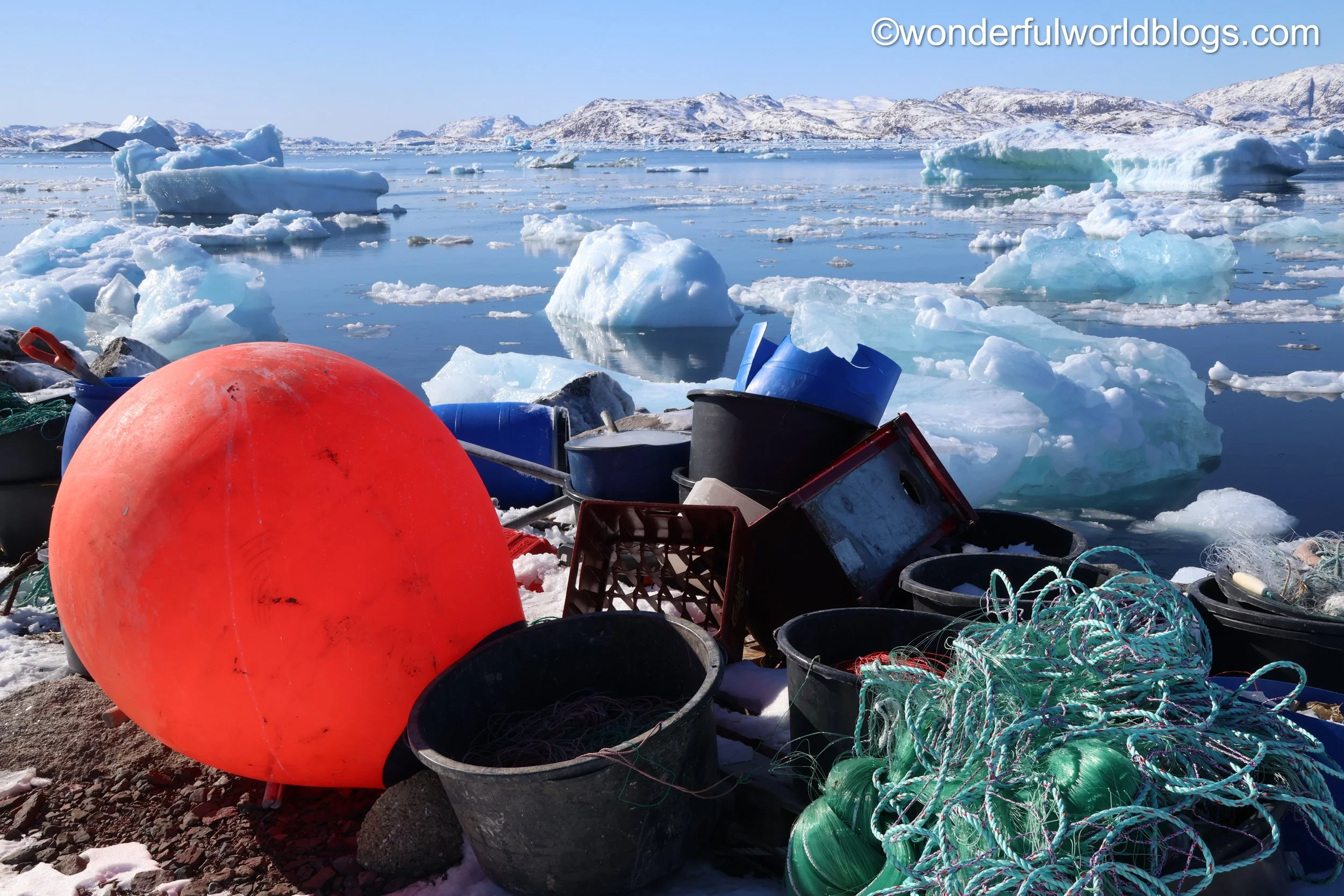
In the rubbish tip near the heliport a jumbled pile of fridges, broken prams and loader buckets from digger trucks lay scattered about, against a backdrop of pristine nature. Between that and the harbour houses and giant boulders, deposited by the ice, cover the gently undulating ground.
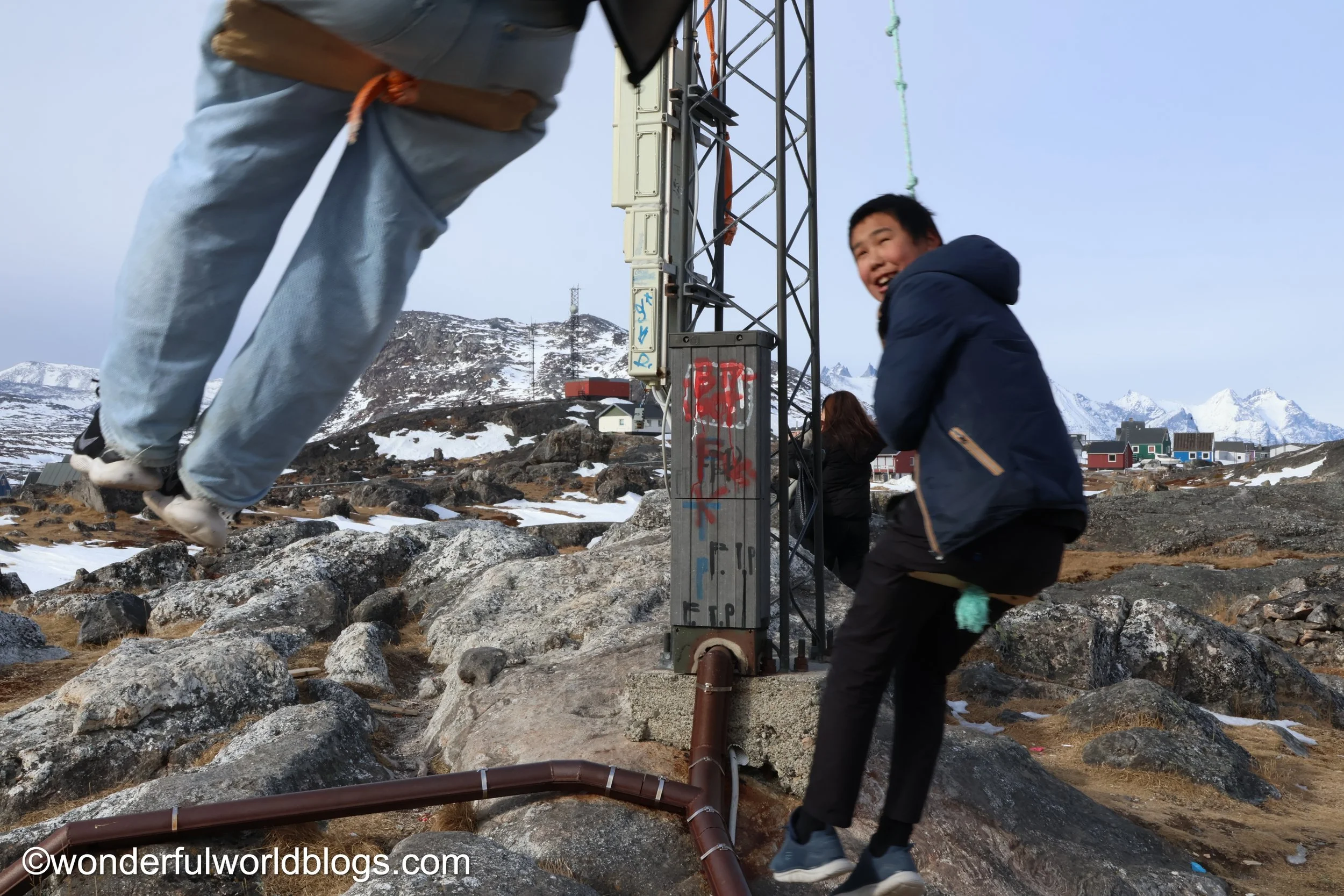
Hiking up Quassik Mountain the sounds of children playing were soon replaced by the calls of ravens, and then by silence. From the top a panorama of snowy peaks towered above the fjord, upon which an iceberg floated like a lonely Viking longship.
The island's other feature is Quaqqarsuasik, meaning "Big Mountain." Through a boulder field, wary of polar bears, I clambered up its steep slope, spindrift blowing across the icy ground. Reaching the rocky peak the ground suddenly fell away to reveal the Labrador Sea far below. I had hoped to take a closer look at the five hundred metre cliffs (off which someone had once jumped with a parachute), but at that moment a vicious snowstorm blew up, stinging my eyes. Beating a retreat the town disappeared in a whiteout several times before I staggered back to the safety of her streets.
Behind the images of polar bears, icebergs and fjords there is another side to Greenland. Researchers describe alcoholism as her “single most important public health challenge" (PubMed, 2020). In Nanortalik I witnessed some extreme examples of drunkenness, with people binging for a whole weekend straight. Apparently drinking for a week is not unknown. In the past a man collapsed outside the bar and died of hypothermia. Heavy drinking often leads to domestic violence and self-harm. Indeed, shockingly, Greenland has the highest suicide rate in the whole world. A lack of job opportunities, poverty, isolation and cultural change are also factors. (This situation is not unique to the indigenous people here: take the Aboriginal people of Australia, for example.)
The town suffers from an unemployment rate of 50%. Despite this there were workers on a construction site from as far afield as Sri Lanka and the town doesn't have a hairdresser. Since the turn of the century about a third of the population have left. But I loved this spectacular, isolated little island, and her warm-hearted people.
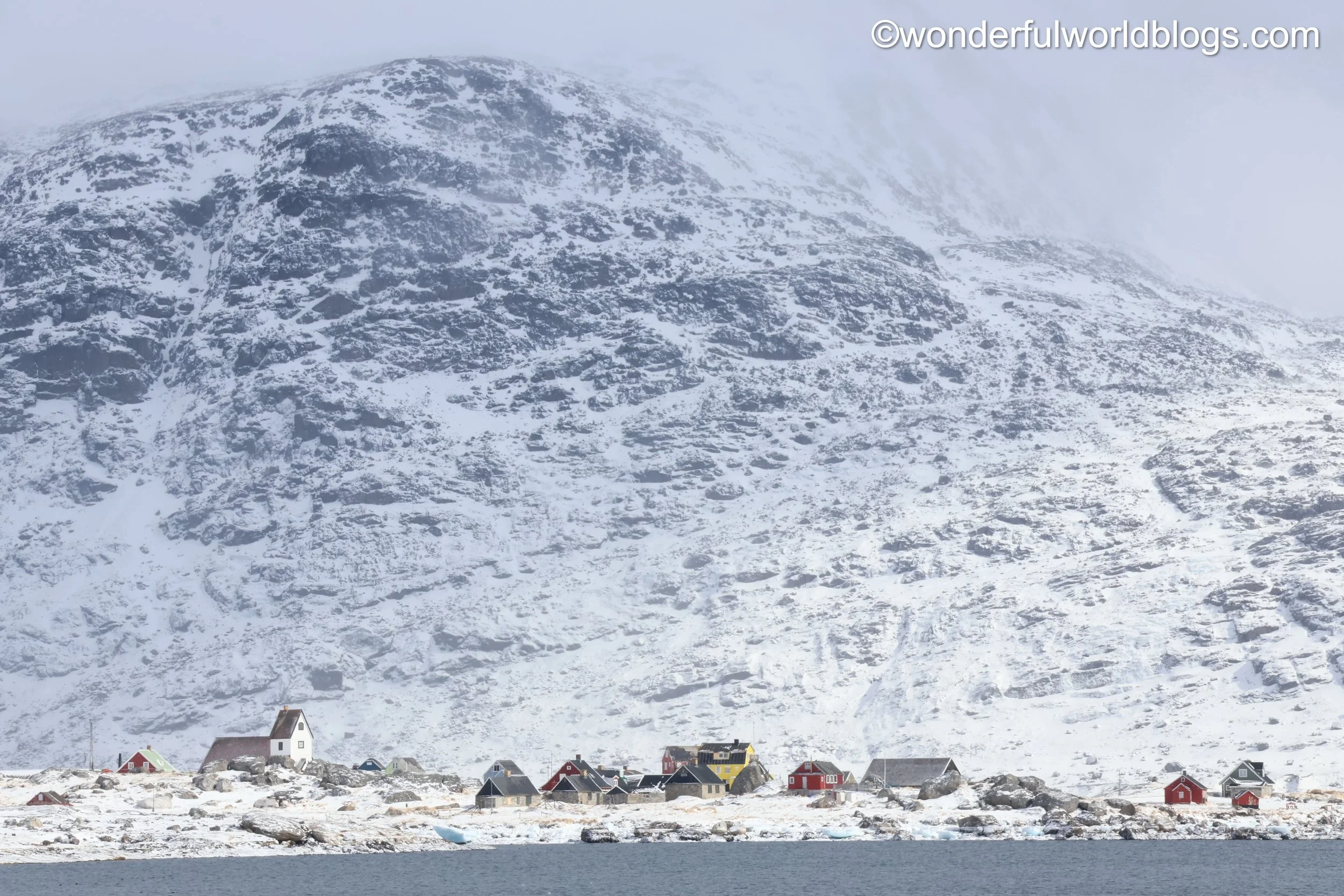
Stuck
If a place is hard to get to then it figures that it might be hard to escape from too. And so it turned out.
A two hour delay for a helicopter on Monday morning turned into a full day's wait, and then a cancellation until the following evening.
Walking into the waiting room for a second time was more an act of hope than expectation given the high winds. Predicting as much the chef in the hotel already had my dinner waiting on the table for when I returned.
The airline, looking at a forecast of high winds and heavy snow, informed me that I would have to wait until Friday before they would even try again. And not without reason. The wind whistled with a vengeance, windows were blacked out with snow and the brave few who had to venture out walked down the street backwards to shield their faces. There were no boats, no helicopters, and no way out. I was stuck.
Talking to my fellow castaways things did not bode well. I heard stories of people having to wait for a week, even for a month, which would which would have tested the patience of a saint. On Thursday though, a glimmer of hope: the storm was abating and a helicopter was scheduled for that evening. I was determined to be on it.
High winds. The departure time came and went. Another two hour delay (to add to the three-and-a-half days and counting), and then, finally, my means of escape set down on the landing pad.
"Sorry Sir, Narsarsuaq hotel is all booked up, I can't let you onto that flight," said the over-officious heliport man. I called the hotel: "I can sleep on a sofa, on the floor, but I need to get on that flight." Then the pilot walked in. Listening to my case, and no doubt noting my growing frustration, he made a few calls. At last, I was in luck. "Have you flown in a helicopter before?" he asked. "Once," I replied. "Then you can take my seat if you like," he quipped.
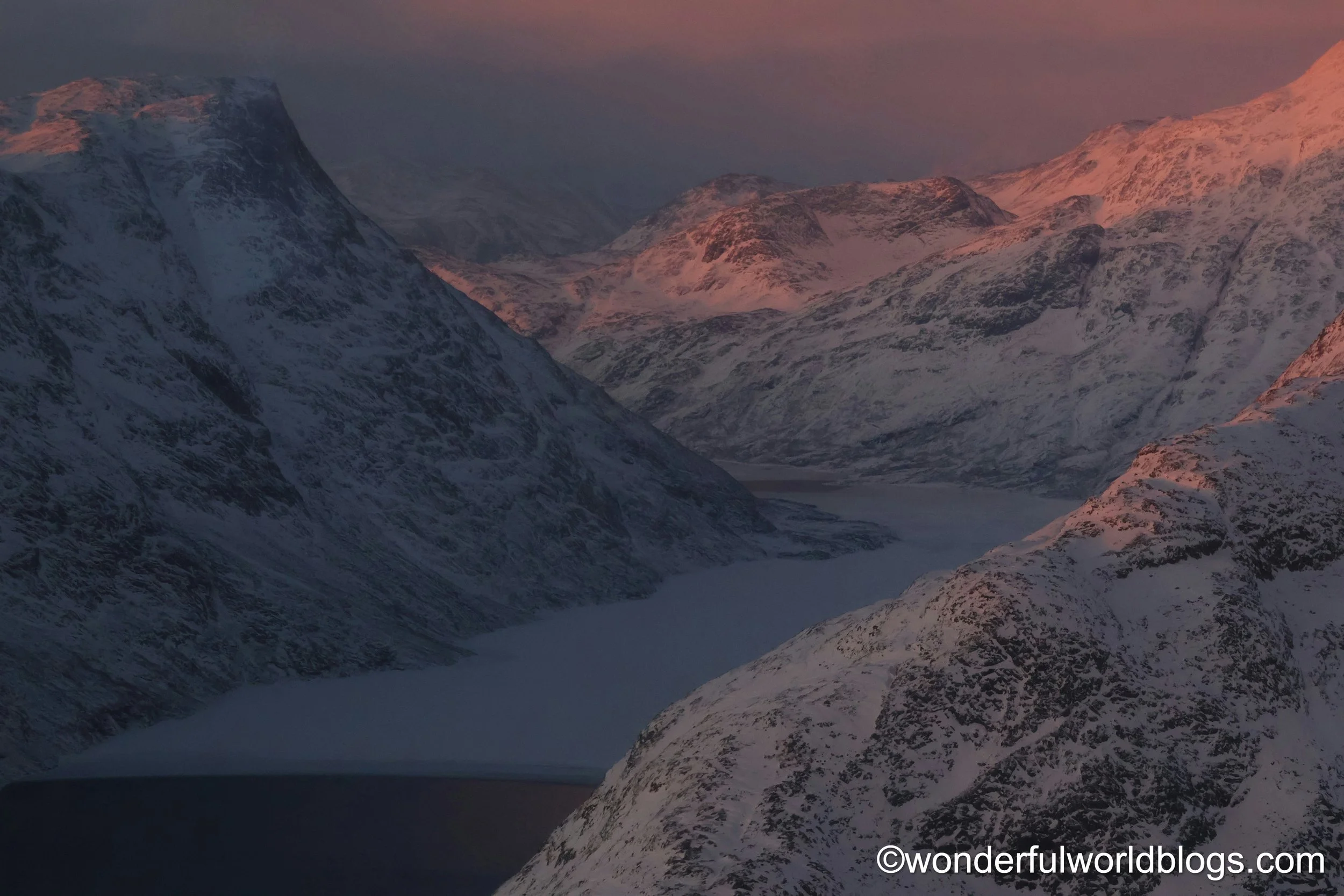
And we were away, lifting off, banking sharply to avoid a mountainside, speeding up the coast above icebergs lashed by the waves, eye-to-eye with snowy peaks glowing pink in the setting sun. Tiny Nanortalik disappeared behind the sheer cliffs of Quaqqarsuasik that I had peered over almost a week before.
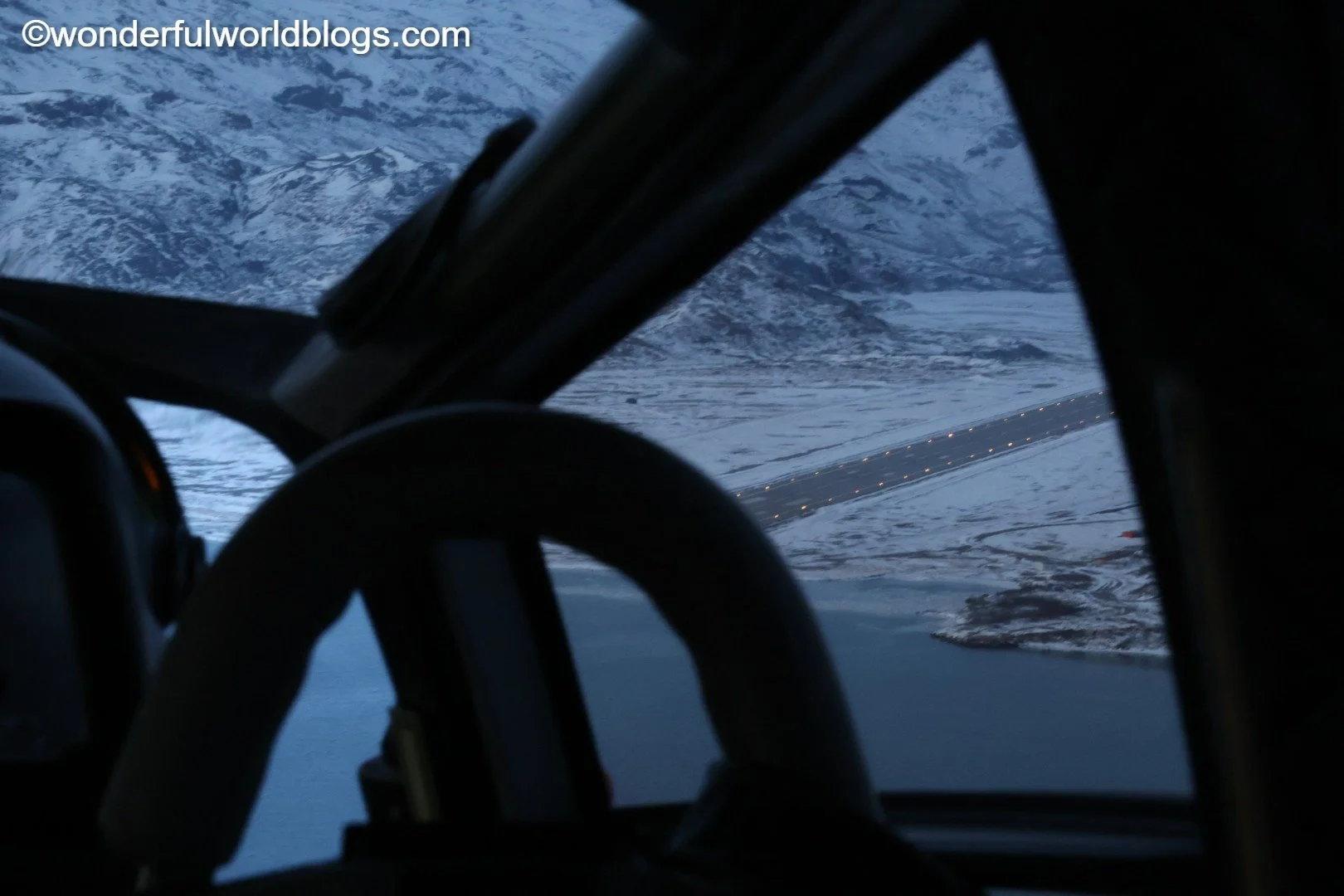
Arriving back in Narsarsuaq by Air Greenland helicopter
Qassiarsuk & Eric the Red
They came from Greenland and across the world to mine for gold. A tough but amiable-looking bunch of men, and one woman, some of the last people to stay at the Narsarsuaq Hotel. Along with the airport it will be shutting down soon, having seen many a character walk through its doors since opening during World War Two.
I had secured passage across the Tunulliarfik Fjord to the small settlement of Qassiarsuk. Here in 982 Eric the Red, escaping bloody disputes in Iceland, found a small black-sand beach to pull up his boat, and enough flat land to establish a farmstead called Brattahliõ. He was far enough up the fjord, he hoped, to evade the attention of any who sought revenge, and in summer, when he arrived, this was a green and fertile land. It is still one of the few parts of the country where crops can be grown.
Climbing up the rickety wooden steps onto the jetty I saw a few men disappear on skidoos and a father and young son - sheep farmers like those Norse settlers from long ago.
By the roadside a sculpture depicts Eric's arrival. He stands erect in his longship, adorned with dragon carvings, arms aloft and spear in hand, his beard unkempt and wild. On the snowy crag above the statue of Leif Erikson has quite a different bearing. He stands proudly, axe by his side, gazing down the fjord towards the sea. A little further down the shore a rough stone jetty juts out into the dark waters. Most likely it was from this exact spot that Leif departed for Newfoundland.
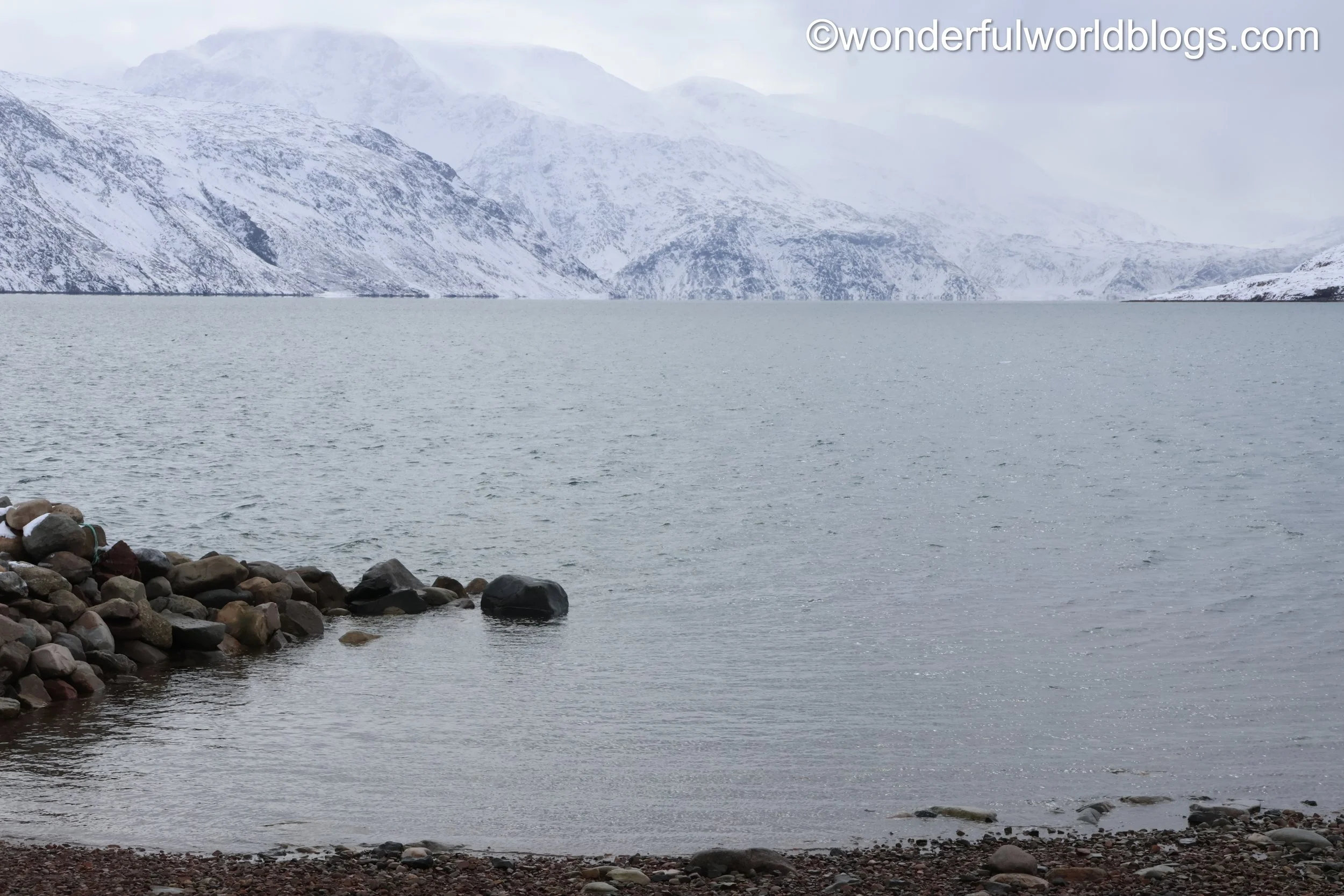
On sheltered ground above are the foundations of a well-built hall. By the size of the stones, some several metres in length, you can surmise that a sizeable community must have dwelt here, and one that was resolved to stay.
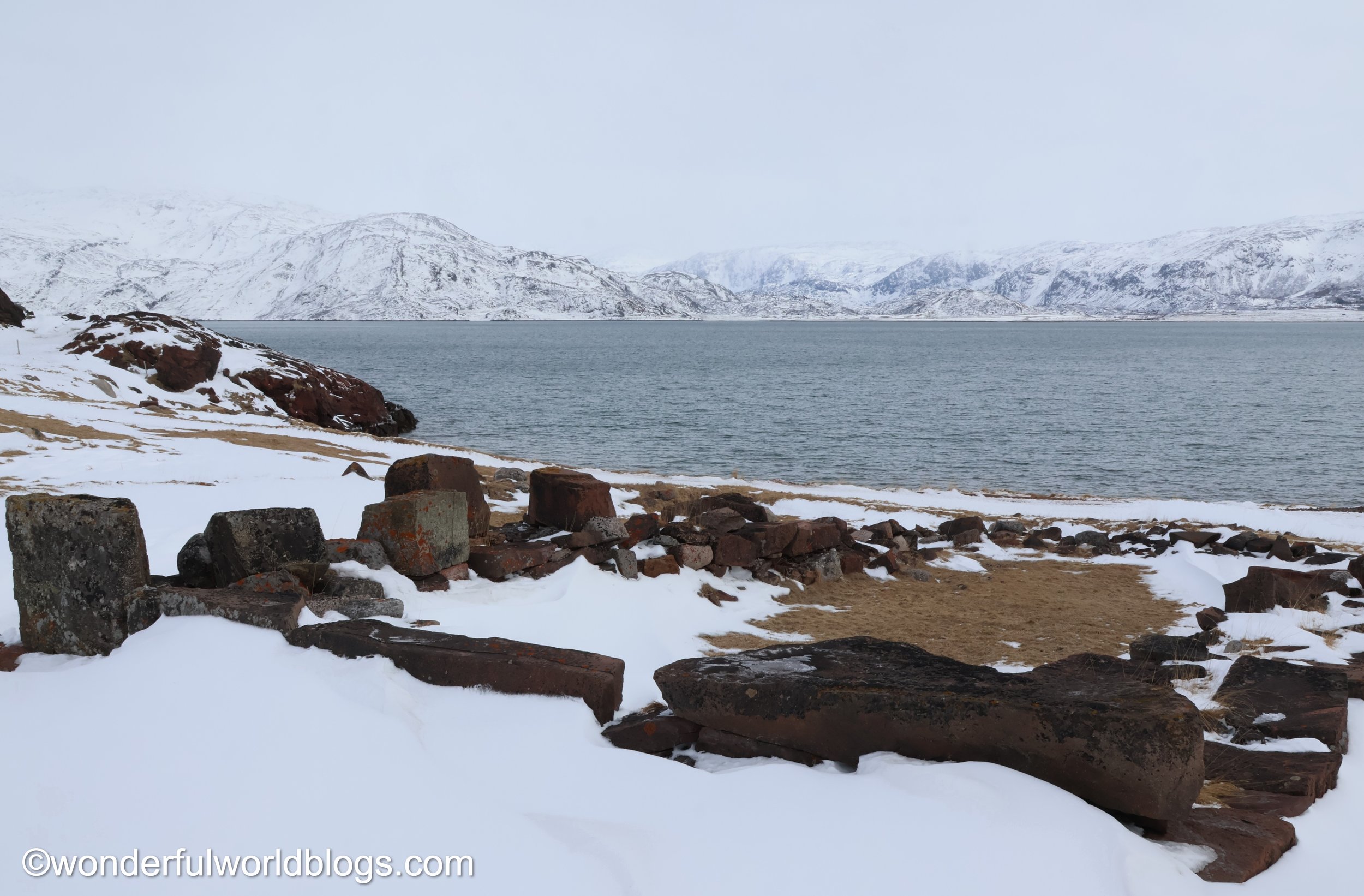
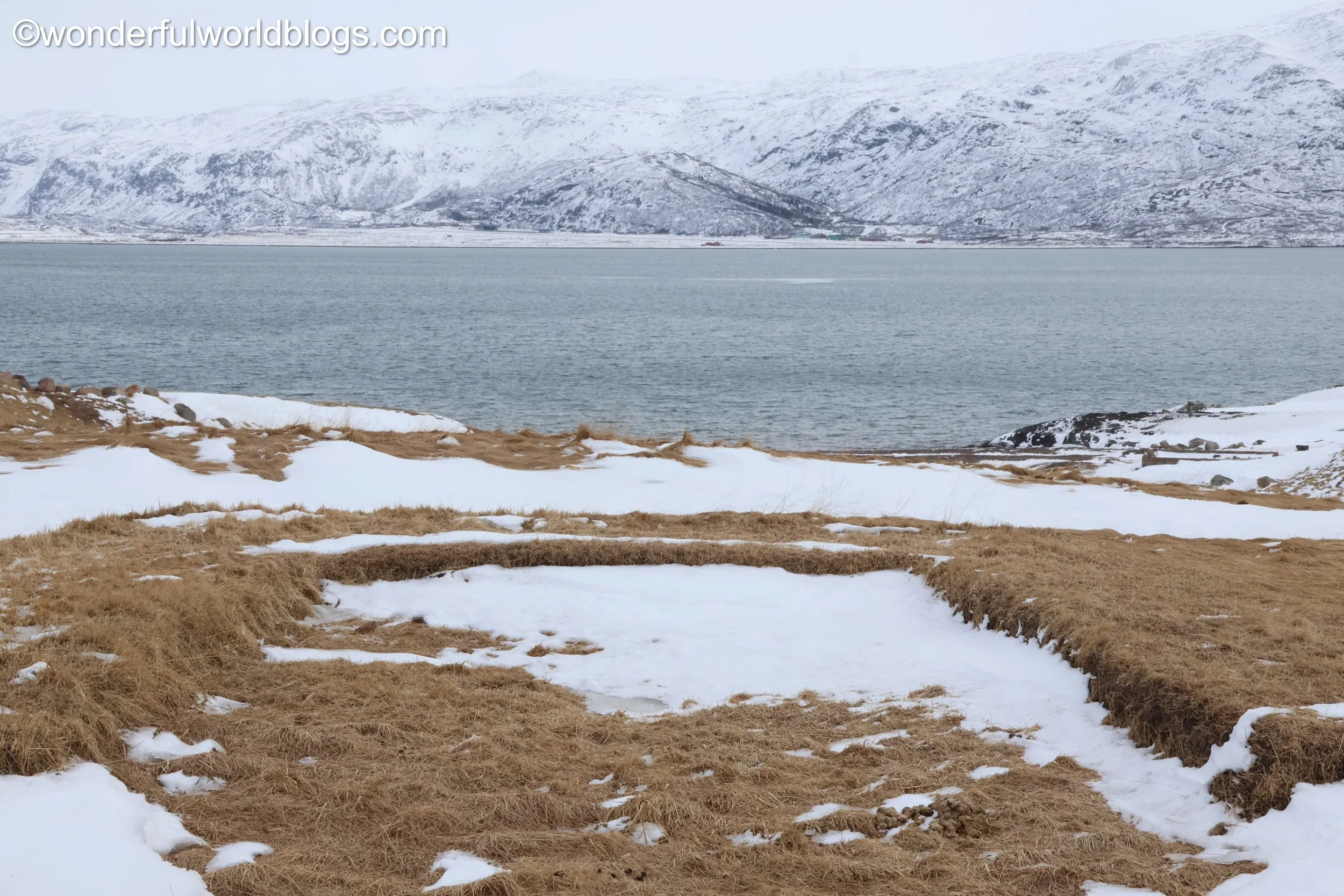
Nearby is a low turf wall enclosing a space of just two by three-and-a-half metres: easily missed, but of great significance. For of all the myriad of churches that now stand to the west of the Atlantic it was on this exact spot, at a simple altar facing east on a floor of red sandstone, that a Christian first knelt down to pray. Her name? Tjodhilde. But if you were married to a hot-headed Viking would you not too seek to find solace in God?
©wonderfulworldblogs.com

Ilulissat
Four days' sail from Qaqortoq the Artic Umiaq Ferry pulls into the harbour at Ilulissat, the last major settlement before the North Pole. Here, 350 kilometres above the Artic Circle, the sun never rises during the winter months. So at noon on the 13th of January people gather on the hill at Seqinniarfik ("the place where we welcome the sun") to celebrate the end of darkness.
The Inuit and their ancestors have lived in the region for more than 4,000 years. Before the arrival of Europeans this was probably the largest settlement in the country, even though there were never more than a few hundred inhabitants. The Norse arrived in the 13th century, followed by Dutch whalers in the 17th. In 1737, after a brief naval battle, the Danes threw the Dutch out and established the town of Jakobshavn. Remarkably this remains the only act of war in Greenlandic history.
Walking up from the shoreline past Zion's Church you reach the birthplace of the town's most famous son, Knud Rasmussen (born in 1879). He collected and published Eskimo Folk Tales and, in his most epic journey, travelled for three years from Greenland to Canada, to Alaska. In a photo, dressed head-to-toe in fur, he could easily be mistaken for the Abominable Snowman. Ironically he died from eating pickled auk (perhaps exclaiming "auk" with his last breath). Given his exploits a more heroic end would have been fitting. Outside his house are parked several sledges, as if waiting for him to embark on another adventure.
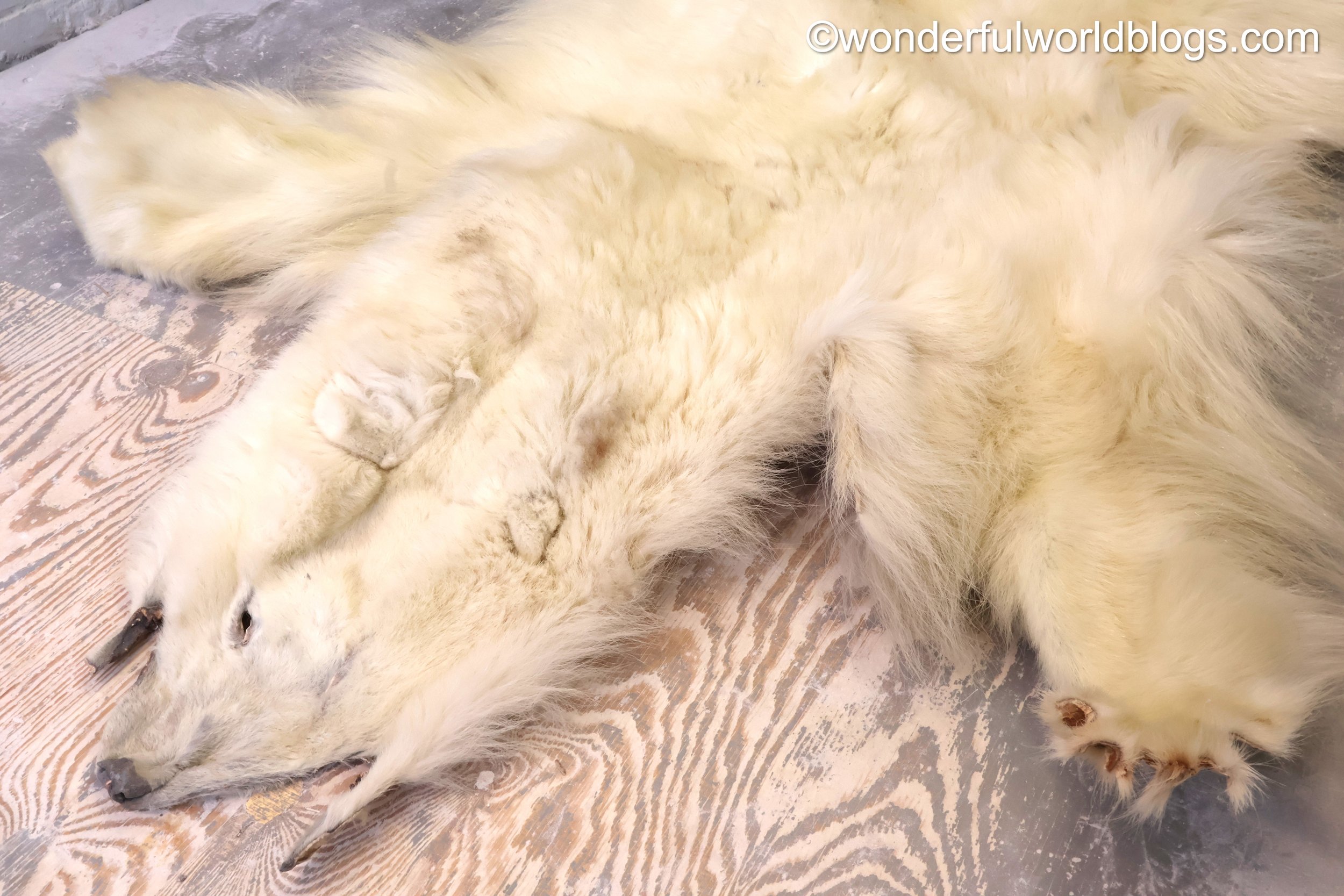
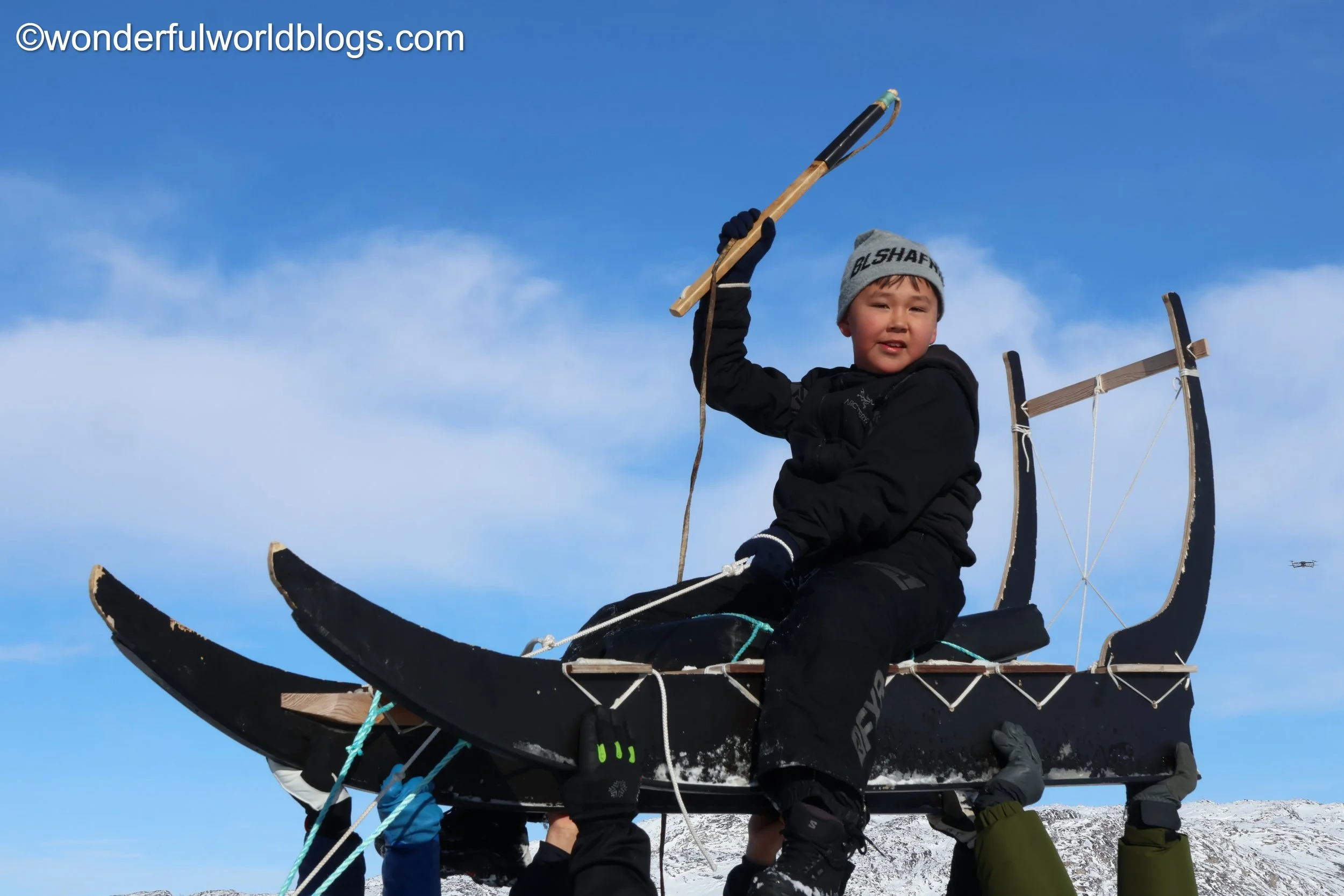
As well as overpriced boutiques (£450 for a musk-ox balaclava anyone?) the town is still a centre of traditional culture. Inside the dusty tupilak workshop, once frequented by Leonardo di Caprio and Martin Clunes, the craftspeople were hard at work. I spotted a complete polar bear pelt on top of a wardrobe, the fur thick and coarse to touch. On a plain in the outskirts a dogsledding race was taking place, cheered on by a large crowd. As the winner approached I was surprised to see a grinning child of about ten at the reins. Crossing the finishing line his sled was lifted aloft in triumph, while the dogs fought viciously over a few scraps. Later I went on a sled ride myself, the only sounds the glide of the runners on the ice, the crack of the whip and the occasional "ee-ee-ee" instruction from the driver, until his mobile rang and he answered "aluu?" Given the ease of travel I couldn't help thinking that between Scott and Amundsen there was only ever going to be one conqueror of the South Pole.
The town has a population of 5,000 humans and 3,000 dogs. On a hill above their barking-mad kennels is the beautifully-designed Icefjord Centre. Unlike most of Greenland's buildings its sleek design blends effortlessly into the surrounding landscape. Exhibits include Eleven Movements of the Cryoscape, which allows you to hear the real-time groaning and cracking of the ice from locations across the country, and ice core samples as old as 124,000 years. Beyond the Centre, over the crest of a hill, the icefjord itself comes into view.
The Sermeq Kujalleq Glacier at its head is six kilometres wide and forty-five kilometres long. It can take an iceberg two years to travel the fifty-five kilometres from its face to the sea. If you look carefully a tideline indicates when a berg has become stuck on the channel bed, though that may be more than a kilometre down. Even viewed from an aeroplane their size is staggering. These are ice-mountains indeed, as tall as city blocks, as long as an aircraft carrier, with designs that Guggeheim or Gaudi could picture only in their wildest dreams. Outside of Antarctica no glacier calves more ice annually: 46km², or forty metres each day. Signs warn you to stay away from the water's edge as a huge new iceberg plunging into the water can cause a tsunami ten metres high. It is no wonder the Inuit named the place Ilulissat, "icebergs."
©wonderfulworldblogs.com
Mummies
(Warning: contains description and images of the dead)
Hans Egede still looks down over the city that he founded. At the foot of the hill upon which his statue stands is Nuuk's modest cathedral, the size of a small parish church, and, by the harbour, his house dating from 1728, the oldest in the country. (It is known as the yellow house, but as several neighbours have chosen to paint their homes the same colour, rather hard to spot.) Today these colonial buildings are dwarfed by the grey tower blocks and commercial premises in the rapidly expanding city centre. And the harbour across town, with its anonymous container ships, is on a different scale altogether.
A short walk from Egede's house are the Kittat workshop, where brightly-coloured traditional costumes are made and repaired, and the small, but profound National Museum. Inside, amongst the kayaks, furry coats and garish masks it is the contents of one darkly-lit room that stand out.
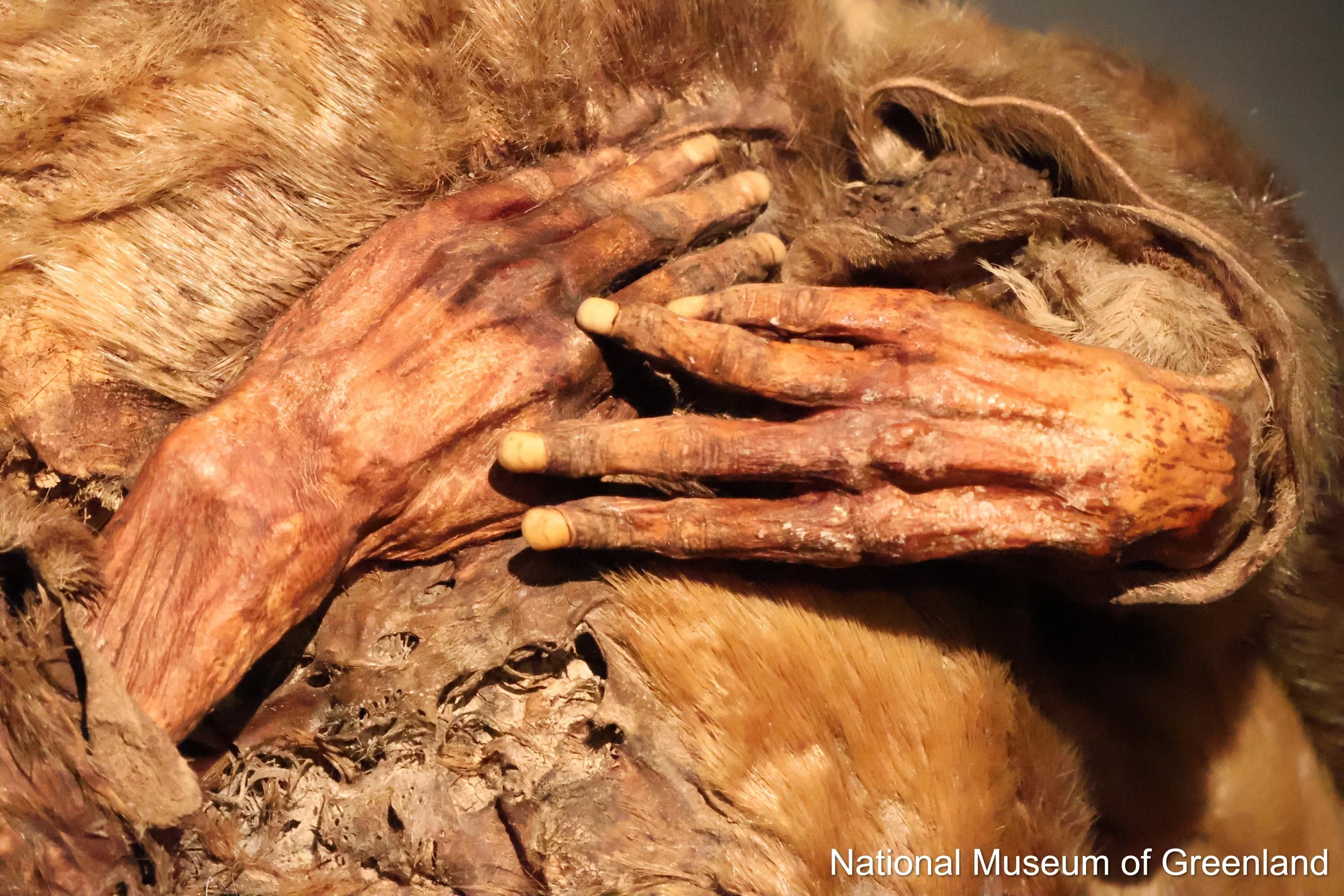
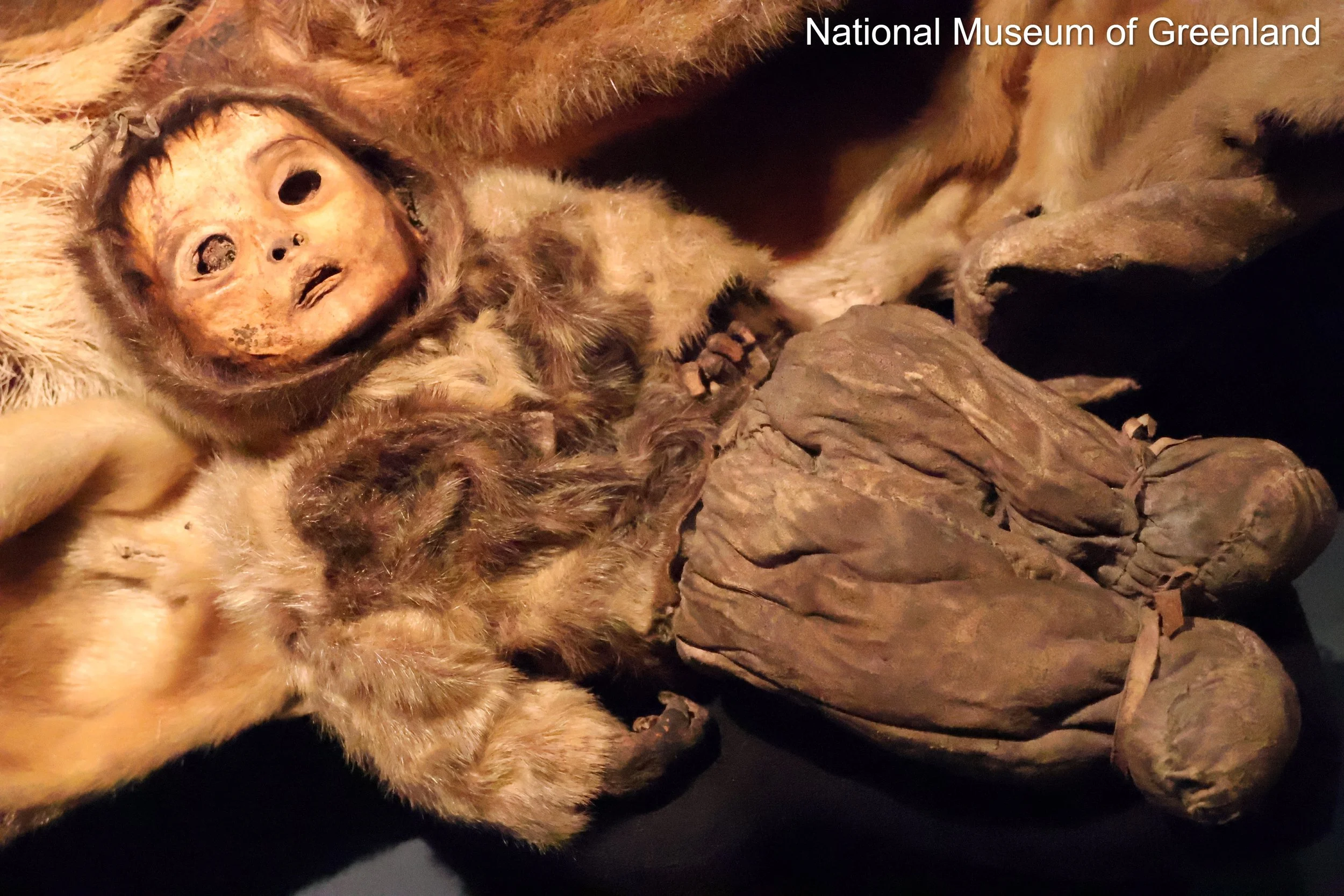
In 1972 Hans and Jokum Grønvold stumbled across something quite extraordinary whilst out hunting in Qilakitsoq, up the coast from Ilulissat, buried under a pile of stones. Carefully removing them one by one they were astonished to find the bodies of six women and two children. They were dressed in reindeer and seal skins. Their underwear was of birds' feathers, and their boots so finely crafted that they were good enough to wear. Their skin was dark, like leather, but with tattoos still visible in places. Their hands, with fingernails still attached, looked like they might belong to a centenarian. Only their skulls, with bared teeth and empty sockets, gave away their extreme age. For, preserved in the cold, dry air, were people from half a millennium ago, dressed in their finest, fully equipped for a long voyage: to the land of the dead. The youngest child was a mere six months old. He was buried alive with his mother, as was the custom if no-one could be found to look after an infant after their parents' death. Today the child's doll-like body still clings to his mother. His empty eyes still seek for love.

A barbers, a bowling alley & a missing nuke
"Can I ask you a few questions about Greenland?" "Of course. As long as you don't want to talk about Donald Trump." Thus began my first ever conversation with an Inuit.
America's interest in the island dates back to 1867. Earlier that year, in a staggering deal, they had bought Alaska from the Russians, doubling the size of the US. Their subsequent plans regarding Greenland failed to make it off the drawing board.
In 1940 the Nazis invaded and occupied Denmark, of which Greenland was a colony. In such a situation the islanders inviting the Americans in to protect them seemed like the lesser of two evils. But the latter have kept a foot in the door ever since.
Post-war the States tried to purchase the island, without success. Then, in 1951, the Greenland Defence Agreement was signed. This allowed the US to keep its bases and to establish new ones with the consent of Greenland, Denmark and the recently founded NATO.
Their most important base was to become Thule, situated in the far north, halfway between Moscow and New York. In a doomsday scenario this remote place, once the site of a peaceful Inuit settlement, would have provided long-range bombers with a place to refuel, given early warning of missiles and intercepted enemy planes. As well as a barbers, bowling alley and bar (the North Star, where no-one ever complained the beer was too warm), nuclear weapons were stockpiled. Unfortunately, in 1968, a B-52 crashed nearby, resulting in extensive radioactive contamination. One of her four thermonuclear bombs is still missing. These days the base is America's only presence in Greenland, but still a vital one. In 2023 she was renamed Pituffik Space Base to reflect her role in the monitoring and control of satellites.
Donald Trump has been interested in acquiring Greenland during both terms of his presidency, purportedly to counter Russian or Chinese aggression in the region. Admittedly, the island would have little chance of defending herself unilaterally. She does not have her own military and in 2020 Denmark's Artic Command consisted of four ships, four helicopters, one maritime patrol aircraft and six dogsled teams (although those dogs are pretty fearsome). But if that were America's real intention then she could simply build a few more bases and bowling alleys and nobody would stop them.
An insight comes from a 2021 interview between Trump and two New York Times journalists, Peter Baker and Susan Glasser. The President admitted he was bewitched by the thought of a deal for the biggest island in the world that would secure his place in history. But there is more to the story even than that.
Gold, diamonds & reindeer burgers
Fishing is by far Greenland's biggest industry, accounting for more than ninety per cent of her exports, and hunting is still an important part of life. However, there is no evidence that battered halibut or reindeer burgers have influenced the US President's decision-making up 'til now. Instead it is what lies underneath the ground that has seized his attention.
Two-thirds the size of India Greenland has some of the greatest stores of natural resources in the world. As well as gold, diamonds, copper and uranium a United States Geological Survey (clearly commissioned out of purely academic interest) estimated that the island and her coastline might hold a staggering 17.5 billion barrels of offshore crude oil (enough to supply the world for six months) and 4.19 trillion cubic meters of natural gas (a whole year's worth). In addition, Greenland holds the largest deposits of rare-earth minerals outside of China (which controls sixty percent of the global supply). You can imagine the conversation in the White House.
However, the island's salvation may lie in her very nature. Eighty percent of her surface is covered in an ice sheet up to two miles deep, and the remainder is mainly precipitous mountains. Only about one percent is habitable. No two towns are linked by road, let alone by railway. Then there is the weather, which limits everything including transport by helicopter and boat (as I experienced myself). As a result, previous efforts at extraction have had little success. The country has never produced petroleum and an attempt to mine iron ore ended in bankruptcy. Despite the desire for new employment opportunities Greenlanders are worried about the environmental consequences and are aware that most of the revenue would probably end up overseas anyway. Even the White House may come to realise that there are easier places to drill.
In 2025 a Danish petition to purchase California from the United States for one trillion dollars garnered 280,000 signatures online. With the slogan "Måke Califørnia Great Ægain" it vowed to "bring hygge to Hollywood, bike lanes to Beverly Hills and organic smørrebrød to every street corner."
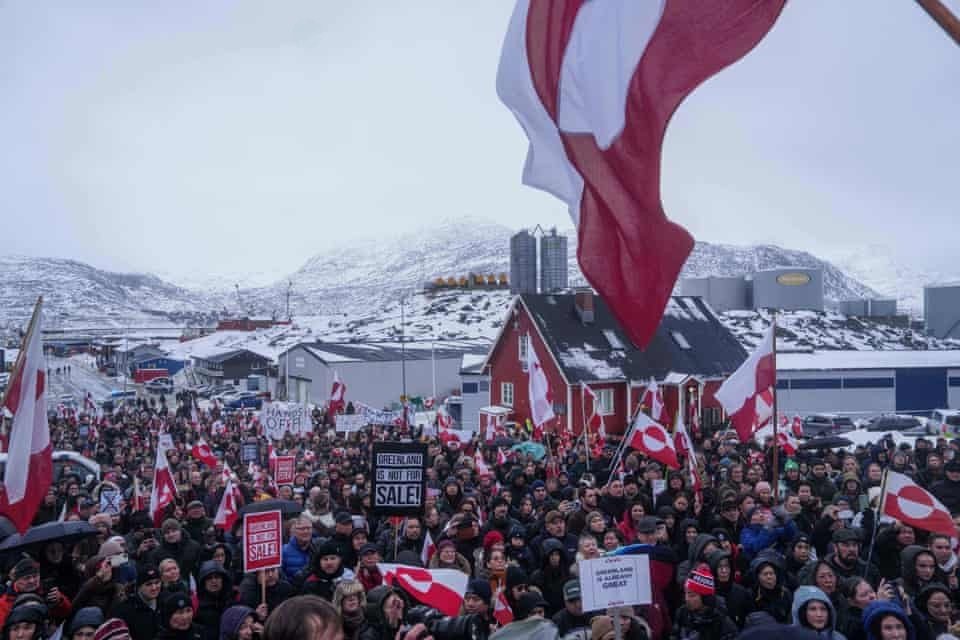
Demonstration in Nuuk
Greenland is not for sale!
MAGA! Make America Go Away!
In a country where a gathering of several hundred is out of the ordinary, the 2026 Hands Off Greenland demonstration in Nuuk drew a crowd of eight thousand, according to organisers. That's 14% of the population - not of the capital, but of the entire island (the equivalent of almost ten million in the UK). A poll the previous year recorded that 85% opposed becoming part of the United States. People's feelings towards Denmark are less straightforward.
Greenland has been a colony since the arrival of Hans Egede in 1721. Although there has never been any large-scale conflict between the two countries the Inuit have been subjected to forced relocation, attempts to prohibit the speaking of Kalaallisut, economic exploitation and systematic racism. In 1951, as "an experiment", twenty-two children were forcibly removed to be raised in Denmark. The impact on their mental health was such that some went to an early grave, while others were prevented from ever returning home. The Coil Campaign, from the 1960s to the 1990s, was an attempt to limit population growth through the fitting of IUDs, often without consent. It is estimated that nearly half the women of child-bearing age, and girls too, were victims, resulting in severe medical and psychological issues. As in other ex-colonies there are high rates of poverty, suicide and alcoholism. Despite the moves towards autonomy in the last fifty years many Greenlanders still feel that they are treated as subordinates in their own country.
Having said that, nowadays most people manage to put aside their differences and live amicably together. After all, the two countries have a long shared history and intermarriage is common. The Prime Minister has a Danish father and a Greenlandic mother. And ties go both ways. While about six thousand Danes live in Greenland up to twenty thousand Inuit live in Denmark.
Their economies are also closely linked. The majority of Greenland's exports go to Denmark, which is also the source of most of her imports. And an annual Danish grant subsidises the economy to the tune of a whopping 20%, funding over half of the education and healthcare budgets. According to recent polling the majority of Greenlanders would vote for independence, but only if it didn't lead to a drop in living standards, which seems unlikely any time soon. Furthermore the question of whether an independent Greenland could resist the grubby paws of the American President may prey on their minds.
Greenland’s ice sheet contains two-thirds of the entire planet's fresh water outside of Antarctica. But with temperatures rising four times faster than elsewhere it is shrinking. It is estimated that if it melted in its entirety global sea levels would rise by seven metres. The Ilulissat Glacier alone retreated by twenty-five kilometres from 1850 to 1950, since which it has lost another forty. Life is changing for the Inuit too. The sledding season is shorter, and the old routes across the sea ice between communities are disappearing.
Past stunted trees and the rusted machinery and broken panes of old warehouses the snow and ice crunched underfoot like pebbles on a beach. Here and there a few patches of foliage poked out - slim pickings for reindeer, but the start of spring. Up above a solitary plane appeared. From its window a uniform whiteness, the land barely distinguishable from the clouds above.
©wonderfulworldblogs.com
Enjoyed the blog? Instantly download beautifully designed PDFs, including the Greenland blog and more destinations, in the Shop.
Lorem ipsum dolor sit amet, consectetur adipiscing elit. Vestibulum id ligula porta felis euismod semper.