
Easter Island & Patagonia
Travel Blog Preview
Travel guide including history, moai
& spectacular landscape photos
El Coro de Rapanui
In 2023 Matthew travelled to Easter Island (Rapanui) and started the remotest choir in the world, only 3512 kilometres from the nearest continent, but conveniently located for singers in downtown Hanga Roa! He would like to express his gratitude to El Coro de Rapanui for their singing and friendship. Scroll down for the full story.
Chile
Chile is the longest, narrowest and southernmost country in the world, squeezed in between the Andes, the second highest mountain range, and the Pacific, the deepest and largest of the oceans, covering a third of the planet. To the north is situated the Atacama, the world's driest desert, while in the south crawl mighty glaciers, heralding the vast white continent of Antarctica. The word Chile may in fact derive from the native Mapuche people's word chilli, meaning “where the land ends”.
In 1520 while attempting to circumnavigate the globe Ferdinand Magellan discovered the strait connecting the Atlantic and Pacific that is now named after him, and became the first European to set foot in Chile. Fifteen years later Diego de Almagro and his band of conquistadors came from Peru seeking gold, driving out the Incas and conquering her for Spain, from whom the country only gained independence in 1810. In 1973 a coup d'état led to a brutal sixteen-year military dictatorship under Augusto Pinochet, during which time thousands of critics of the regime “disappeared”. Since regaining her freedom Chile has prospered, and is now the richest country per capita in Latin America. The blue of her flag signifies the sky, the white the snow of the Andes, the red the blood that was spilt during the wars of independence, and the star her hope for the future.
Santiago
Santiago (St James) was a 1st century Christian martyr whose remains are supposed to be buried in the cathedral of Santiago in north western Spain. (On a previous trip I climbed the Pyrenees and crossed almost 500 miles of blister-inducing plains, passing Pamplona, the mighty cathedrals of Burgos and Leon and perfectly preserved Roman bridges to reach the cathedral and gain a Compostela.) Santiago de Chile, on the other hand, is situated in the foothills of the Andes along the Mapocho River, originally the homeland of the Picunches people. In 1541 in an epic journey the conquistador Pedro de Valdivia, sent by the famous Pizarro, endured almost three thousand kilometres of the tortuous Inca Trail from Cusco and seized the city for Spain.
Today Santiago is a large, modern, polluted capital city, with seven million inhabitants (40% of the country's population). The cathedral, dating from 1561, is situated on the Plaza de Armas. Where once there were gallows today there is a statue of the freedom fighter Simón Bolivar, shaded by palm trees. The streets around are enlivened by cheerful Chilenos, musicians and clowns. The city boasts the second highest building in Latin America and a central station designed by Gustavo Eiffel, but suffers from frequent earthquakes, including the 6th largest ever recorded.
Pablo Neruda
Pablo Neruda (1904-73) won the Nobel Prize for Literature and is considered Chile's national poet. His work is by turns political, romantic and surreal. His Veinte Poemas de Amor y una Canción Desperada (Twenty Love Poems and a Song of Despair) is still the best-selling work of poetry in Spanish. As a sign of someone who would go far, he published his first article - Entusiasmo y Perseverancia (Enthusiasm and Perseverance) - in a local newspaper under a pseudonym when he was only thirteen. Later on he became a member of the Chilean Communist Party and was awarded the Stalin Peace Prize. When Communism was outlawed he was forced to hide for months in the basement of a friend's flat in Valparaiso, before fleeing over the Andes to Argentina on horseback. Years later he was invited back by the President of Chile, and subsequently read his poems at the Estadio National in front of a crowd of seventy thousand people.
Neruda's house, La Chascona, is situated in a bohemian quarter of Santiago, its name inspired by the curly red hair of his lover Matilde Urrutia. The rooms reflect the poet's artistic bent and quirky sense of humour, and are packed with objects from his travels around the world: English crockery, Russian dolls, African statues, Chinese paintings and one of Matilde by Diego Rivera. There are also salt and pepper pots inscribed with the words “marijuana” and “morphine”, and several bars.
During the Pinochet coup d'état, while the house was being searched by soldiers, Neruda remarked: "Look around, but there's only one thing of danger to you here – my poetry." In his Memorial de Isla Negra he wrote: "Something stirred in my soul...and I made my own way, deciphering that fire and wrote the first faint line...and suddenly I saw the heavens unfastened and open."
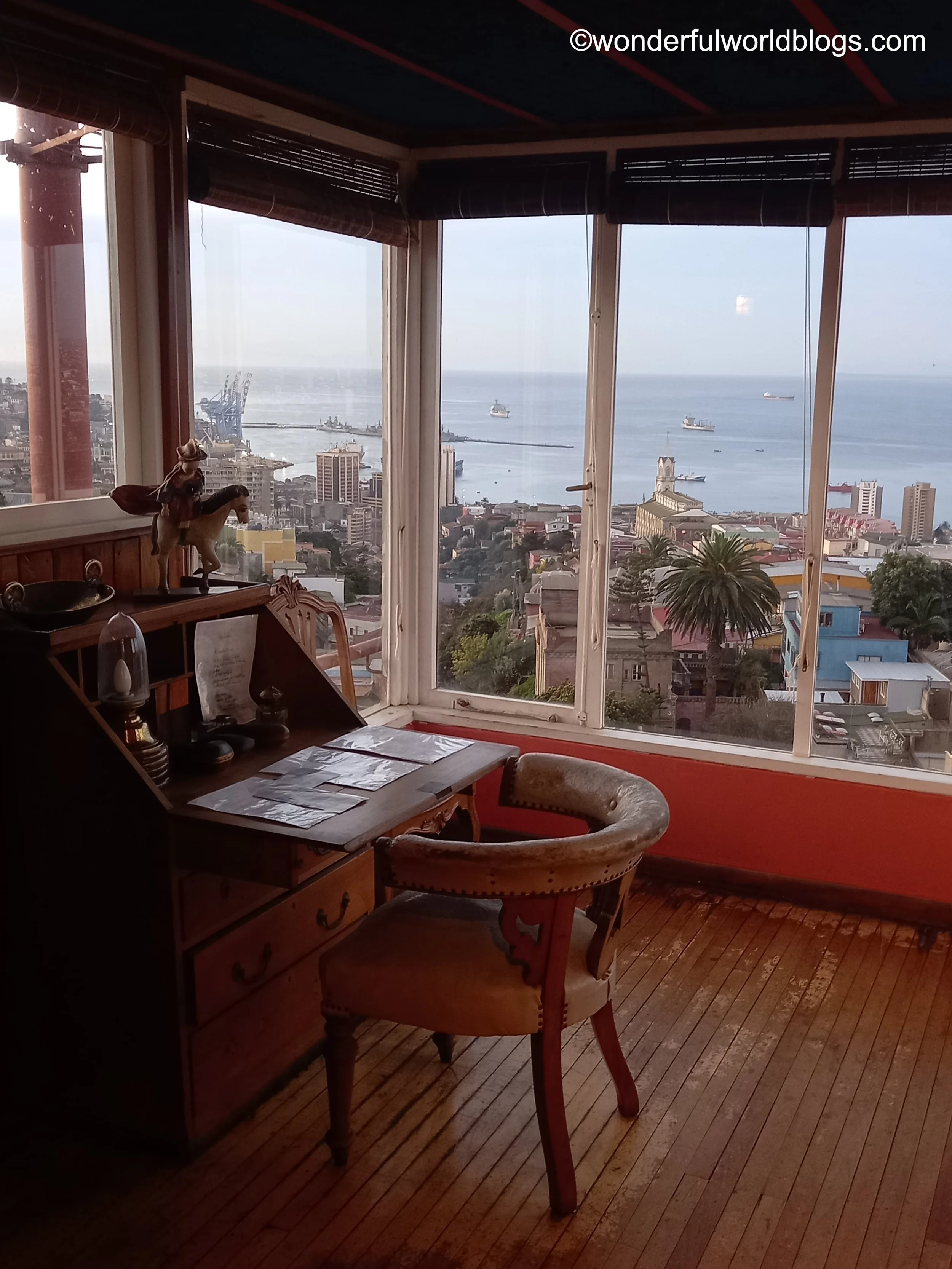
Pablo Neruda's study overlooking Valparaiso
Valparaiso
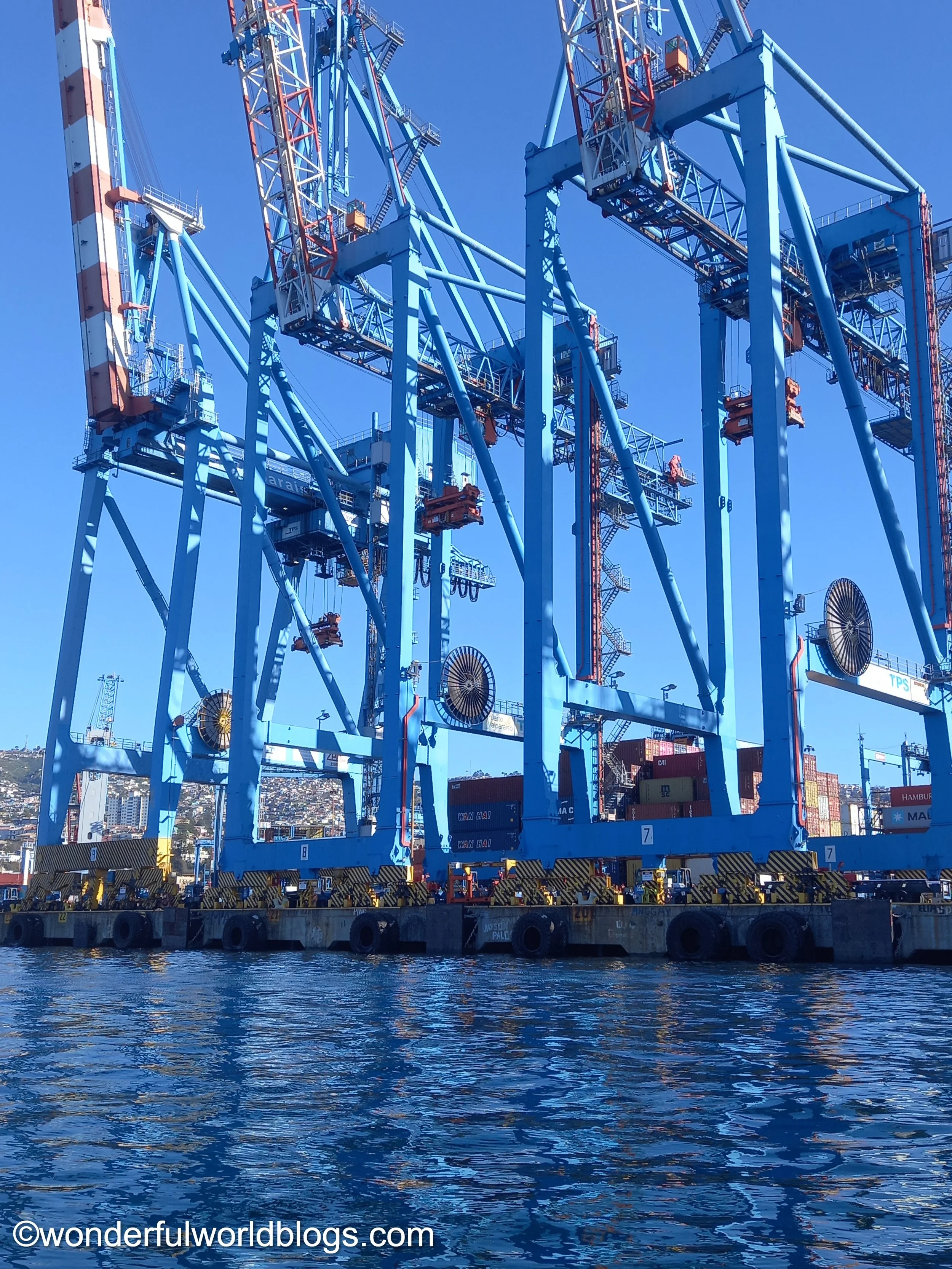
An hour from Santiago I caught my first sight of the Pacific and the rather optimistically named Valparaiso, Valley of Paradise. Originally home to the Picunche people and later raided by English pirates such as Francis Drake, this port town was a stopover for vessels including whalers navigating Cape Horn en route for the Pacific. Although its fortunes plummeted after the building of the Panama Canal today the harbour is still alive with vessels, markets and the shouts of sailors and salesmen. Precipitous roads and alleyways covered with graffiti run down from the surrounding hills past closely-packed dwellings, a haven for philosophers, painters and poets. Perched high on a hill with a view of the whole panorama is another of Neruda's quirky homes, La Sebastiana. Meanwhile out in the bay Chilean navy destroyers, massive container ships, playful little tugs and sealions rise and fall on the glistening sea.
©wonderfulworldblogs.com
Rapanui
In about 1200 AD Polynesian, sailors fleeing conflict with other islanders, using only the stars and the flight of birds to navigate, sighted a triangular island formed of three volcanoes which they were to call Rapanui, meaning “big Rapa”, or Te pito o te henua, “The Navel of the World”. It was a momentous occasion in the history of mankind - the last step of our sixty-thousand-year journey out of Africa to inhabit the whole planet.
The island is among of the most isolated of all inhabited places. The nearest settlement, Pitcairn Island, is 2075 kilometres away, and has a population of only fifty, mainly descendants of the mutineers from the Bounty. The nearest continental point is Chile, 3512 kilometres away, while to the west lies Tahiti, at a distant 4231 kilometres.
Rather than the natural beauty of its volcanic craters and its spectacular coastline the island has become famous around the world for its nearly thousand extant moai, the biggest of which at eighty tons is twice the size of the largest stones at Stonehenge. The statues, created to honour ancestors, face inland both to watch over their descendants, and because the islanders for over half a millennium believed there was no civilisation beyond their shores.
The fate of the moai is linked to that of the islanders. When Captain Cook visited in 1774 he found virtually all of the statues toppled or defaced, and the population impoverished and struggling to survive. Tragically it seems that the statues, despite the huge labour involved in their construction and placement around the coastline, had been intentionally toppled, perhaps as a kind of revenge for their failure to protect the Rapanui from decline.
Enjoyed the preview? Instantly download beautifully designed PDFs, including the complete Easter Island and Patagonia blog and more destinations, in the Shop. Includes Easter Island’s dramatic sights, Patagonia, the Perito Moreno Glacier, El Chaltén, Torres del Paine and Ushuaia.
Lorem ipsum dolor sit amet, consectetur adipiscing elit. Vestibulum id ligula porta felis euismod semper.