Madagascar
travel blog
See the Madagascar photo gallery here
For many the word Madagascar conjures up images of a group of animals who escape from New York Zoo to an island in the Indian Ocean, where they encounter lemurs singing, "I like to move it, move it!"
Mada, as the locals call it, broke off from Africa 160 million years ago. It is the world's oldest and fourth largest island, twice the size of Britain. As a result of its long isolation more than 90% of its wildlife is endemic. Strange denizens include the rhino chameleon, the now extinct elephant bird, and the puma-like fossa, which eats lemurs, so was the baddie in the Madagascar movies. In addition there are more than a hundred species of all-singin'-n-dancin' lemurs. The animal life has a varied diet with around 15,000 species of plants to munch on. While Britain has thirty species of trees Mada has a thousand, including the iconic baobab, the Tree of Life, which can grow up to thirty metres tall and live for a thousand years.
The island was first settled in about 800 AD by sailors from the Malay Archipelago and subsequently by East Africans and Arabs. Given its favourable geographical position the inhabitants have always traded widely, with goods including vanilla (about 85% of the world's supply today) and, in former times, its own people, sold as slaves. Trade made it an attractive target for pirates, especially during the 16th to 18th centuries, and they established their own kingdom, Libertatia, on Île Sainte-Marie off the east coast.
By the turn of the 19th century King Andrianampoinimerina had united the various tribes and established the capital Antananarivo, or Tana for short. The French had long coveted the island and in 1895 they invaded and subjugated the population.
During World War Two Mada came under the control of Vichy France, who were allied to the Germans. They were defeated by the British at the Battle of Madagascar, after which the island reverted to control by the Free French. They might have been free but the Malagasy people only secured their own freedom in 1960.
The relationship between the two countries remains complicated. Although the President has French citizenship and French is still widely spoken the people resent the power that the country continues to exert, and some do not celebrate Independence Day, believing that Mada is still not entirely free. Croissants are one of the few elements of French rule that are still popular.
One thing that does unite the country is the Malagasy language, spoken proudly wherever you go. It is not related to African tongues but to languages from South East Asia and even the South Pacific. Indeed, the locals do not consider their country to be part of Africa.
Despite its idyllic portrayal in the movies the country is beset by deep-rooted problems. It is the tenth poorest nation in the world. The average annual salary is under £2,000 and a third of the population live on less than £1 a day. There is a general lack of infrastructure and the roads are poor. Nearby Mauritius is 250 times smaller, but fifteen times richer.
The tenfold growth in the population in the last century, to about thirty million, the majority of whom work the land, has led to great pressure on the environment. Widespread use of slash and burn has resulted in the destruction of 90% of the forests. (In Britain only about 2.5% remains, so we can't preach.) This in turn has worsened the effects of the frequent and serious floods that occur. Nowadays 95% of the wildlife is threatened with extinction and the problems are set to worsen due to climate change. Even though large parts of the country are designated as national parks the next few decades will be critical for the future of Madagascar.
Antananarivo
Stopping overnight in Addis Ababa Ethiopian Airlines provided free accommodation in a newly-built hotel. At the sumptuous buffet dinner I met members of the Namibian Olympic team, training hard for the Paris Games. Later I took a taxi and toured the dusty, high-rise city centre, its boulevards lined by palm trees and women forced to work the streets.
Arriving in Antananarivo the air was warm, and polluted. Outside the airport ladies in traditional dress welcomed visitors with a kind of line-dance performed to raucous jazz. Driven into town by a local called Liva we passed rice paddies and advertising hoardings before arriving in the densely-packed buildings of the Basse Ville.
Tana is situated on the Hauts Plateaux, a mountainous spine running down the centre of the country that reaches heights of almost 3,000 metres. This blocks the rain from the Indian Ocean from reaching the west, where droughts can last up to ten months. The city was founded in 1610 by King Adrianjaka who successfully united the country's tribes. He built a Rova (fortress) on the top of what was to become the Haute-Ville and stationed a garrison of troops there, giving the city its name, Antananarivo, which means "place of a thousand soldiers."
The Rova was home to the Merina royal family for three-hundred years until the French abolished the monarchy in 1896. Originally built of wood the fortress burnt down in the late 19th century and was rebuilt in stone (traditionally used only for tombs), only to burn down again in the late 20th, necessitating yet another rebuild.
The main street of the Basse Ville (originally named Avenue Fallières but renamed Avenue de l'Indépendance) resembles a provincial French town of the 1960s, and some buildings retain the signage of that time. There is a town hall and an ornately-decorated gare. Although there have been no trains for years distances in Madagascar are still measured from there. At the top of the Avenue is the Analakely Market, the oldest and biggest in the country, under whose red-tiled roofs one can buy everything from wedding dresses to pigs' heads.
©wonderfulworldblogs.com
Antsirabe
Leaving the vibrant streets of Tana behind I set off south in a 4x4 in the company of Liva, the quietly-spoken family man whom I had met me at the airport, and Yennifer, a multilingual hairdresser from Honduras who, despite her petite size, carried a bag about four times as big as mine.
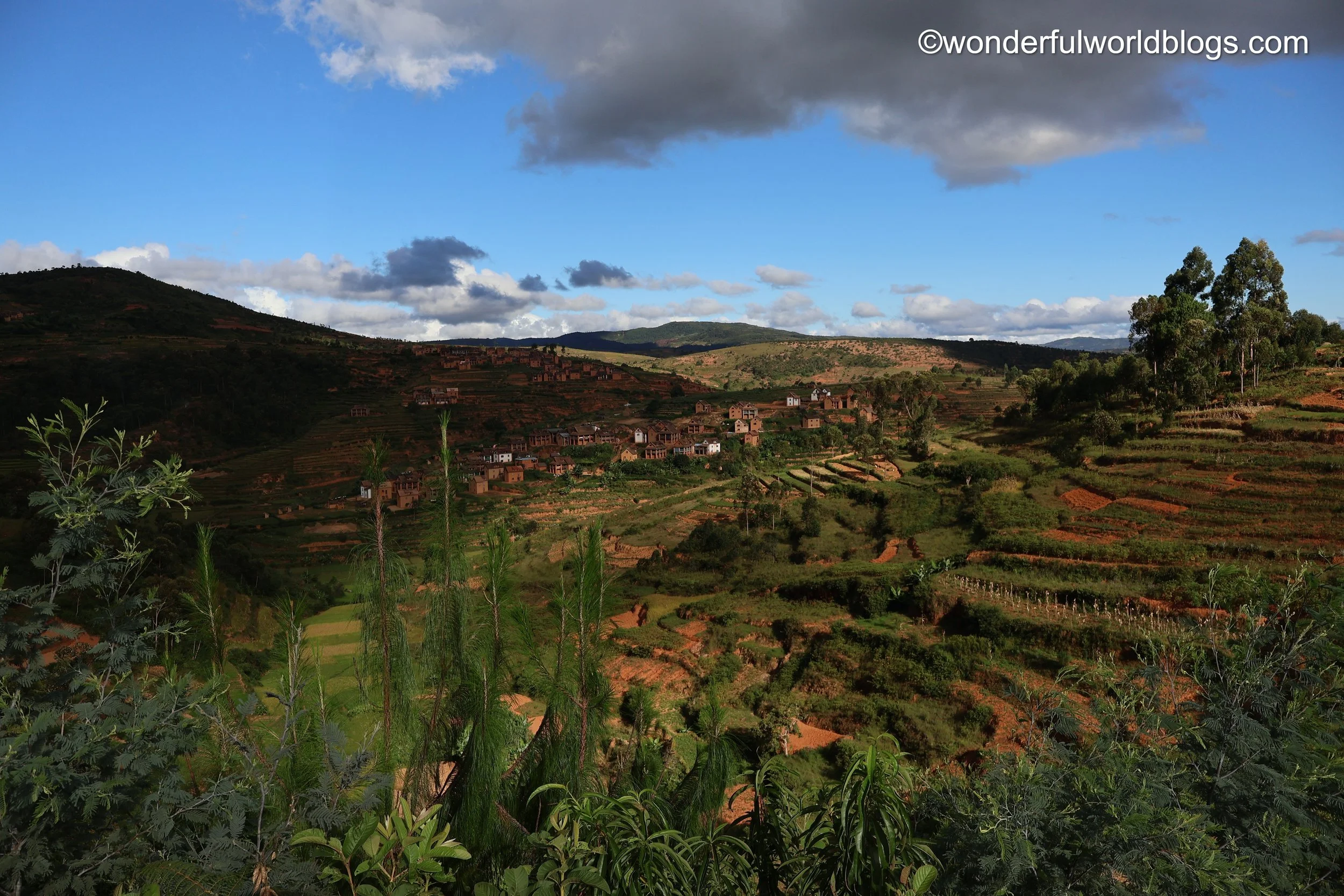
The scenery was unchanging. Where once there had been forests now the rolling hills are covered by rice paddies with only little clumps of trees remaining, like patches of hair on a bald man's head. I passed through rickety, one-street towns, and women doing their laundry in rivers, spreading out the clothes on the riverbanks in a multi-coloured patchwork. I crossed abandoned railway lines and passed zebu* carts piled high with crops and big lorries belching forth black clouds, like dragons in a bad mood.
(*The zebu, known as a “camel cow” due to the hump on its back, is the ever-present beast of burden here. They are often quite skinny but have nasty looking horns. Despite being sacred they are a constant feature on menus, which dishes ranging from zebu burger to zebu stew.)
In the little town of Antsirabe a stream of rickshaws carried the lazy to a raucous funfair. The old railway station stood silent and the hot springs, that once hosted the King of Morocco, echoed only to the sound of children playing.
A journey that would take two hours in the UK takes five here. Lina was constantly having to swerve to avoid huge potholes, and these only got bigger the further we travelled from Antananarivo, despite this being the main and only road down the east coast.
The next day a young guide took me to see the traditional Beatafo villages of the Merino people. They grow a great variety of crops in the red volcanic soil, including carrots, soya beans and avacados, which some boys were busy stealing as I passed.
On the tops of the surrounding hills are stone tombs from where the dead keep watch on their ancestors, like Moai on Easter Island. The Merino follow the practice of Famadihana by which every seven years relatives open up the family tomb, take out the remains and sing, dance and feast to celebrate and reconnect with the remains of their loved ones, before reburying the happy dead in fresh shrouds.

If you are enjoying WWB
please Buy me a coffee
by clicking on the image above.
This will help fund the website
& future projects.
Thanks for your support!
Matthew
Ambositra
Reaching the outskirts of Ambositra in the Hauts Plateaux I saw a rickshaw driver and his client careering downhill, fast, without brakes, as quick as the poor man's bare feet could carry him. In the centre of town a troop of soldiers, men and women in sky-blue uniforms, were lining up proudly if casually to salute their flag. I attended a carpentry workshop. It seems unlikely that the accompanying shops, crammed floor to ceiling with gifts, will ever attract enough tourists to reduce their stock.
Leaving town the interminable rice paddies gave way to green hills scattered with giant boulders. Out of the soil rose little two-story thatched cottages, made of earth and wood. From a distance, amongst the patchwork of greens, they reminded me of Cézanne's Post-Impressionist works from the south of France.
I passed crowds of colourfully dressed people with Easter bonnets or baskets balanced on their heads, and beggars, young and old, exhibiting varying degrees of desperation. Heading downhill we drove past a little hand-pushed cart, which they call a kalesa, with a few kids on the back and a sleepy pink pig on a bed of straw on the front.
Climbing now the trees gathered ever more closely together until finally, a full three days and four hundred kilometres from Antananarivo, the rice paddies gave way to jungle. Here at last was the landscape that I had expected to see in Madagascar.
Ranomafana
The patches of jungle and other unspoilt landscapes that do survive mostly fall within one of the country’s national parks. Although these cover only three per cent of the land due to economic and political instability even these aren't completely safe.
Ranomafana National Park - founded in 1991 and named after local hot springs - is one of the success stories. There one can hike for a week through rainforest containing 250 rare species of plants, including herbs to treat travel sickness, sexual disfunction and even hangovers, plus a dozen species of lemur.
Lemurs, from the Latin lemures, meaning “ghosts” or “spirits”, evolved separately from monkeys and apes, and range in weight from the thirty-gram mouse lemur to the nine-kilogram indri. There used to be giant lemurs, but these were driven to extinction by the arrival of humans. Nowadays, despite their fame from the Madagascar films, 90% of the hundred or so species are endangered, largely due to the loss of their habitat.
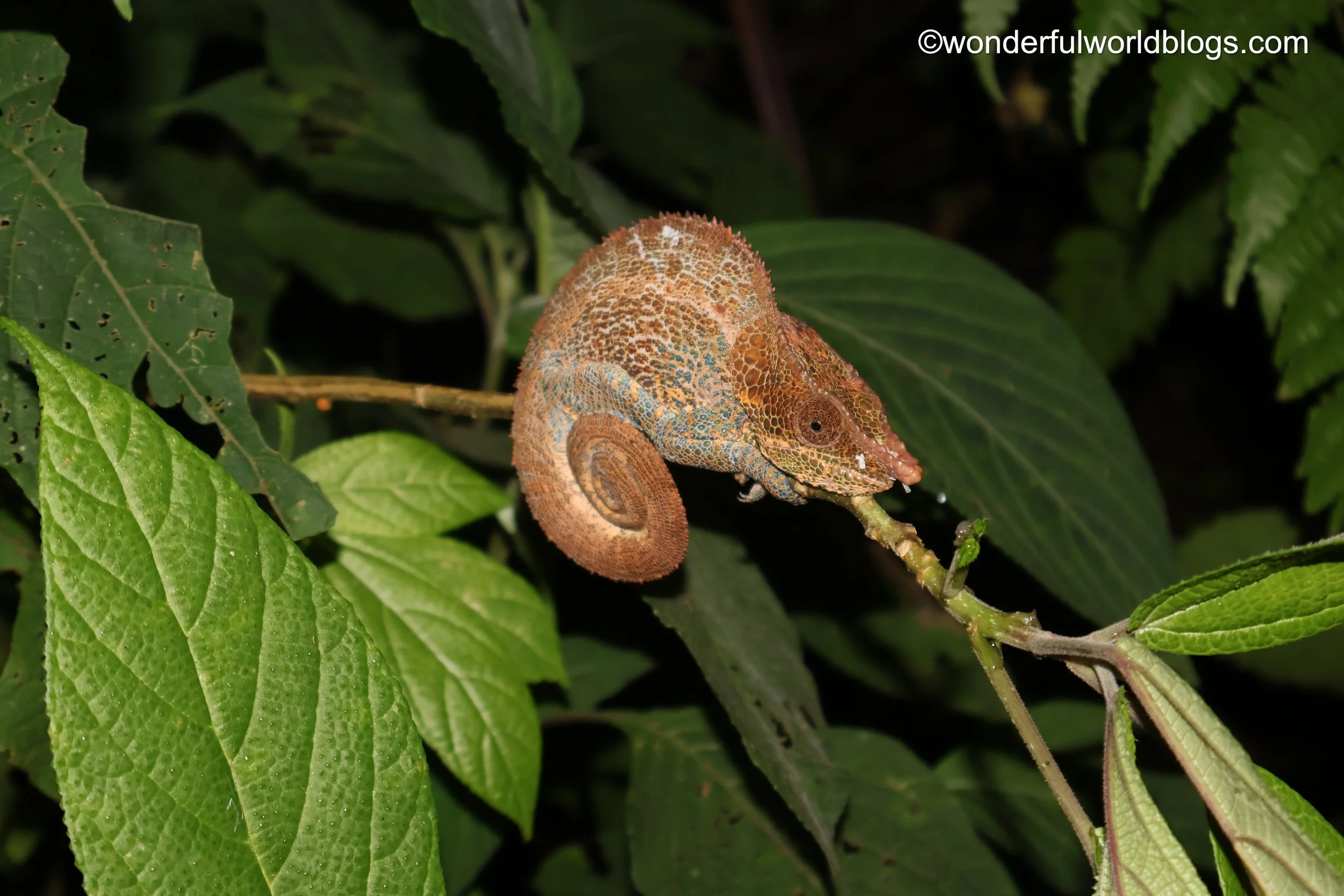
Entering Ranomafana, breathing deeply the fresh and humid air, it didn't take long for my guide (one of the Antanala forest tribe) to spot a small green chameleon, which otherwise I would have missed completely. Trying to avoid poisonous plants and scorpions that happened to be catching forty winks in my vicinity, I ambled down a muddy path cut through the otherwise impenetrable foliage. Before long a troop of camera-wielding tourists signified that my first lemur sighting was at hand. True to their persona in the movies they are lively, sociable animals that are so used to benign human contact that they are happy to continue frolicking about in the treetops even when a family with noisy kids or a German with an abnormally long camera lens station themselves nearby.
In another part of the jungle a rare Greater Bamboo Lemur was munching away on her favourite snack right above my head, so close that when she dropped it I almost picked it up and returned it to her with my kind regards! Sadly the family of this lonesome lemur had been killed by its mortal enemy the fossa. Conservationists intend to introduce her to another family in the hope that they will adopt her. (There's a plot for another movie right there.)
Later I went on a night walk and spotted a tiny mouse lemur (the favourite snack of a whole host of predators), a pair of birds sleeping side-by-side on a branch, an array of beautiful chameleons and several snakes looking to gobble them all up if only they got the chance. My guide attempted to chat up the local frog population with authentic-sounding "ribbits", without success. But he did pass on some priceless information about what to do if you encounter a Boa Constrictor. “If it raises its head back off slowly. If it turns to one side grab it near the head with one hand, and further down with the other, while holding it as far as possible from you.” Fortunately the opportunity to get in some practice did not arise.
Gazing at a crowd of tourists straining to catch a glimpse of a mouse lemur I couldn't help but wonder: do the government and the population at large really understand quite how essential the wildlife here is to the economy? If these fragile species ceased to exist how many tourists would still come?
Fianarantsoa
Once through Ranomafana's busy Easter market the road followed a deep gorge through the jungle. But soon enough the trees were replaced by rice paddies. No longer lemur habitat, but a rural landscape of great beauty nonetheless, a kaleidoscope of greens growing out of the fertile red earth, against a backdrop of picturesque mountains.
Travelling down the progressively worse road (five minutes with no potholes was a surprise), through little towns with youthful crowds in their Easter best (teenage parents are very common here) I arrived at the Sahambavy tea plantation and factory. It was closed but the gate was manned by Felix, a smiling local who had worked there for fifty years, and he agreed to show me around. The machinery didn't look as if it had been upgraded during his entire career, but from the aroma there's no doubt they make a good cup of tea.
Further south lies the city of Fianarantsoa, established two hundred years ago by the Merina as the capital of the newly conquered Betsileo kingdom. The name means "good education" (my guide certainly spoke good English and Italian), and it is one of the cultural and intellectual hotspots of the country. There is a university, a cathedral and a Protestant church that is the oldest brick building in the south.
Like in Antananarivo Fiana's Rova is built on top of the Haute-Ville, a peaceful hill with cobbled streets running down to the Mandranofotsy River. The fortress is long gone. All that remains is a twisted old fig tree with a story or two to tell and, in the playground of the primary school on the site, a long human-shaped stone upon which prisoners were once decapitated. (I wonder how the teachers explain that in class.)
As the sun set we drove through Alpine-style mountains, their tops disappearing into the billowing clouds, before descending to a broad plain. By the roadside a group of little kids spontaneously broke into a street dance, like the "I like to move it, move it" lemurs in the movie.
Ambalavao
That night I arrived in Ambalavao, a low-rise town of dark, dirt streets illuminated only by the stars above, with one of the biggest zebu markets in the country. Apart from a tour of the Atelier Papier Antaimoro where smiling ladies demonstrated how to make paper from tree bark, what will stick in a memory was a night club where a very drunk crowd danced wildly (but well) to raucous African pop, while my distracted driver Liva had his phone stolen from his pocket.
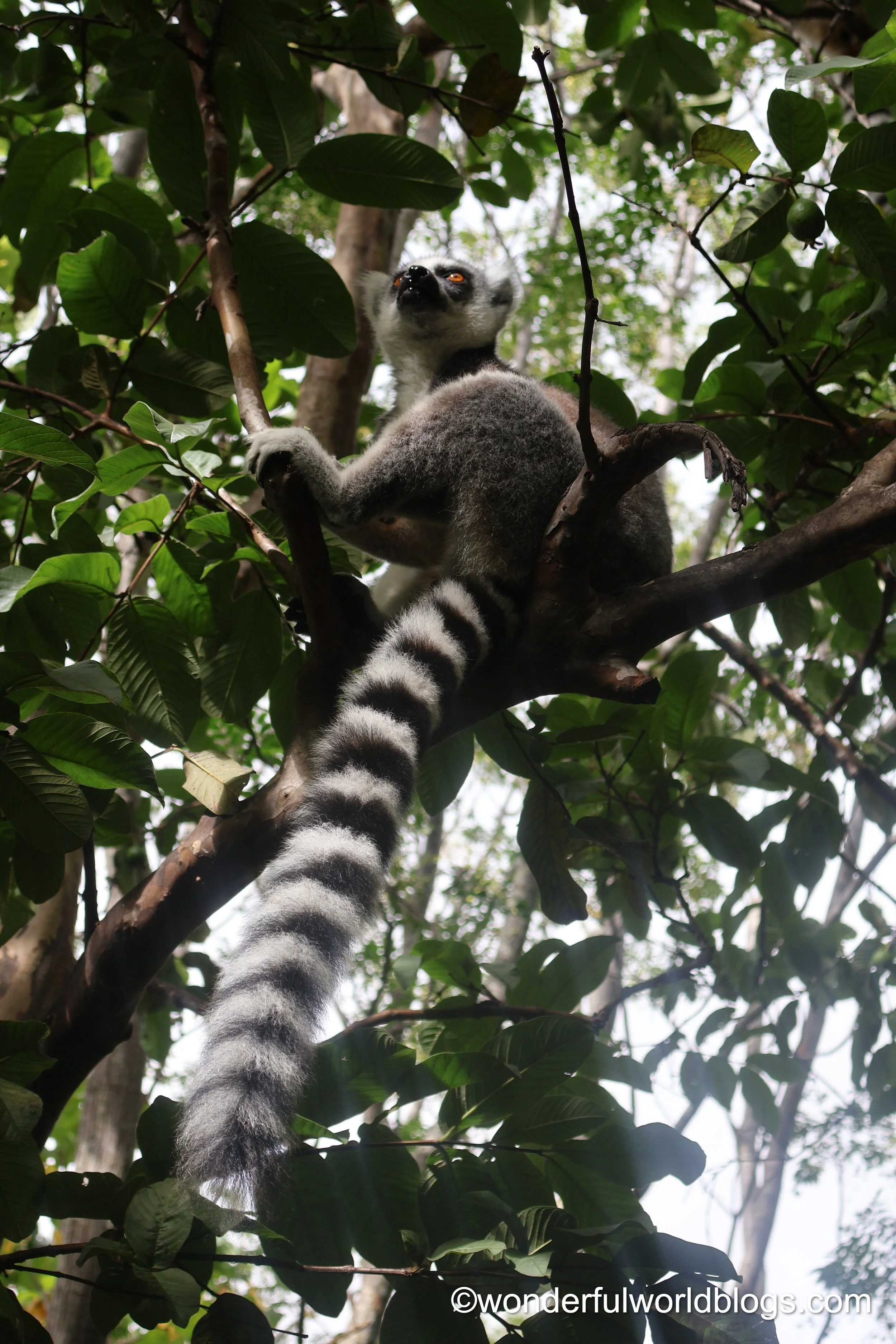
The nearby Réserve d'Anja, situated in a stunning valley overlooked by the Three Sisters Mountains, is a hugely successful community-run wildlife project. In a surprisingly small patch of forest I saw one of the largest of chameleons - its long tongue shooting out to catch insects offered on a stick - and met members of the six hundred strong population of Ring-Tailed Lemurs. Sitting on branches right above my head with their distinctive and fashionably-striped tails hanging down, they nonchalantly went about their business. In a cave system at the foot of the mountains that extends for eight kilometers villagers once hid from their Merina and French enemies and buried their dead.
©wonderfulworldblogs.com

If you are enjoying WWB
please Buy me a coffee
by clicking on the image above.
This will help fund the website
& future projects.
Thanks for your support!
Matthew
Tsaranoro
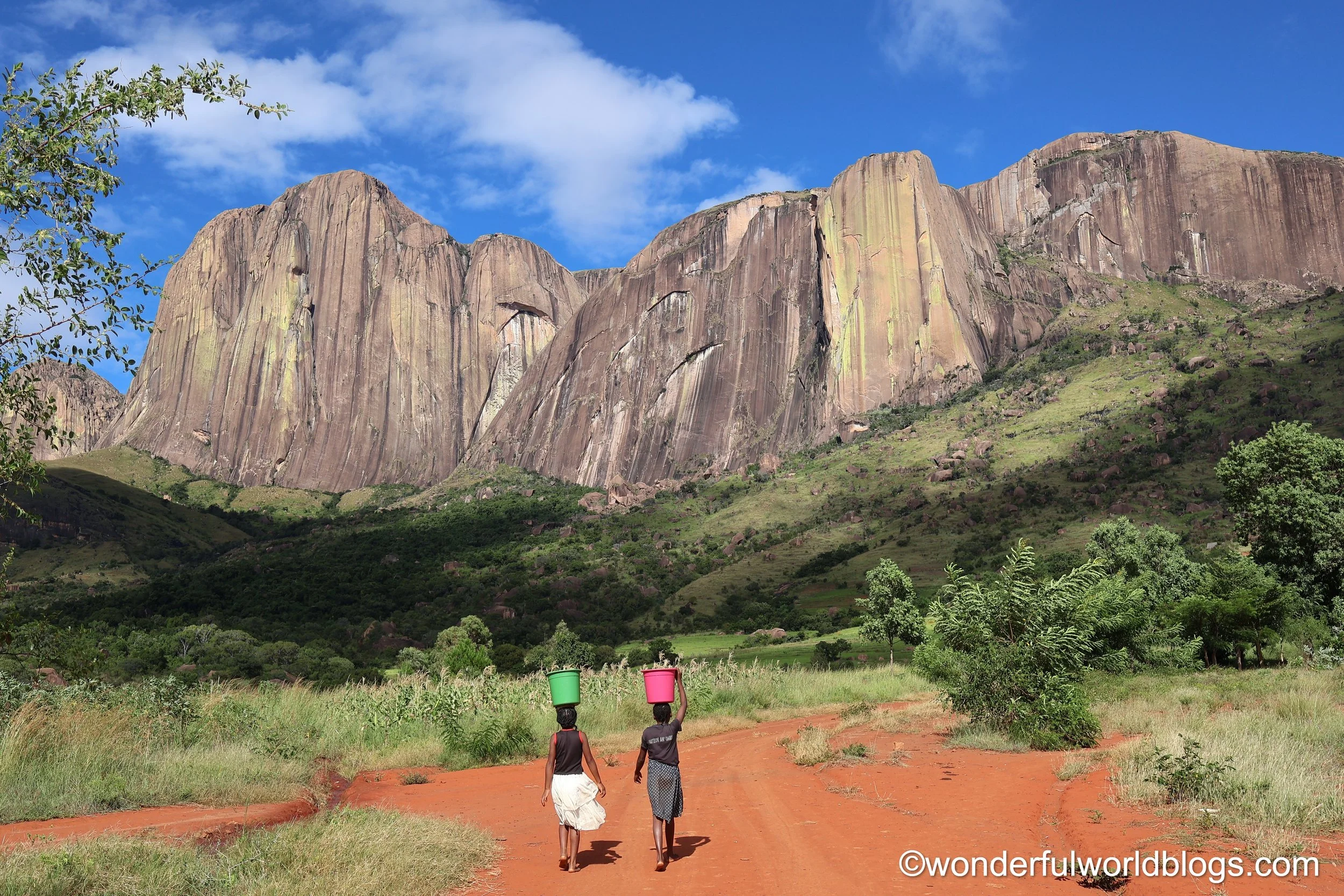
If the main road is bad enough when you turn off it you had better be in a 4x4 or on foot as a normal car wouldn't get far. Indeed parts of the National Park of Andringitra became inaccessible recently due to cyclone damage to vital bridges. Driving down the bumpy Tsaranoro valley at dusk the only other traffic was a zebu jam. The majestic mountains, like great castles disappearing into the clouds (including the country's second highest peak, Pic Boby, at 2658m), reminded me of Patagonia. This place is hard to get to, but spectacular and unspoilt, populated by thriving, smiling Betsileo and Bara communities. Without electricity or water they have to walk down to the river everyday with pots balanced on their heads.
That night I was drawn up the hill from camp by the sound of vivacious singing accompanied by guitar, percussion and ad hoc shrieks, as a group of locals celebrated a birthday. The ladies danced in a circle (the men weren't drunk enough to join in, I was told) with steps reminiscent of the Big Apple jazz dance from '20s New York.
Tsaranoro Mountain is named after the daughters of King Sahanambo. Its sheer 800 metre face is beloved by climbers and base jumpers. On the way up I passed a baby lemur poking its head up from behind a rock and the Chameleon Mountain, the shape of its peak bearing a striking resemblance to its namesake, its face changing colour in the shifting light like Rouen Cathedral in Monet's famous series of paintings. The following, without exaggeration, is a true one of my experience on Tsaranoro Mountain.
The steep ascent was tiring, but the difficulties really started on the way down, after a lunch eaten sheltering in a cave. To begin with there were large stretches of smooth, sloping rock that would have been okay if they hadn't been made dangerously slippery by the incessant rain, and if the only place to halt your slide hadn't been a nasty-looking bed of cacti. Then I entered a narrow ravine. Clambering over the boulders it was not so much a question of "mind your step", as "mind your step to avoid breaking an ankle or leg." Then on one side the way was flooded, while on the other the rock face was as slippery as an eel. I was stuck.
After what seemed like an age of abandonment, during which my increasingly frantic calls for help echoed away without reply, one of the guides who had gone on ahead suddenly threw a long rope down allowing me to pull myself up to safety, at least temporarily.
Catching my breath I found myself on a high rocky platform with sheer cliffs falling away in all directions. I was informed that the only way to escape was to climb up and then abseil down the other side. Although by this point I was seriously considering whether base jumping might actually be an easier option on reflection a 150 metre abseil down a perilously steep slope with no safety harness seemed preferable. I couldn't help recalling what a German lady had told me the previous evening: "When abseiling down a steep, life-threatening face it is not recommended to let go."
Arriving back in camp, my legs like jelly and my nerves not much better, the guide had the temerity to ask if I was tired. "Pas du tout", I lied. Tsaranoro Mountain - a once-in-a-lifetime experience, please.
Isalo
I hope to return to Tsaranoro one day, to be as one with her beautiful mountains, to experience the way of life of her people once again. Now zebu carts, people carrying baskets on their heads, pounding rice, living in mud and thatch cottages, and crowds of smiling kids greeting you wherever you go, seem as normal as the streets of London.
We crossed huge plains with strangely shaped mountains then reached a high, arid plateau. Stopping at a restaurant for lunch two young boys begged for food, seemingly pleased with the left-over rice and biscuits I offered them. Down the road I bought water from an Italian man who had lived happily in this dusty little town for forty years, a long way from his home in Bergamo.
Then followed more plains but with a line of mountains on the horizon rising up like battlements, guarded in my imagination by armoured chameleons and nimble lemurs, the National Park of Isalo.
Climbing a sandstone escarpment with wide ranging views of the Ihorombe Plateau below I spied one of the tombs of the Bara people on the cliff face opposite, where my guide told me his father was buried. Along the path there was a tiny coffin decorated with toys, once favourite playthings of the small child within.
The vegetation was expertly adapted to the harsh heat reflecting up from the dry, rocky ground. The tapia tree has waxy leaves that preserve water and its little green fruit feed silk worms that in turn produce a soft wrapping for the dead. If a swim in the idyllic Piscine Naturelle helped me to cool off temporarily I was soon parched again on the long hot slog that followed. Descending into a canyon, my good mood having long since evaporated, my spirits were lifted by a family of lemurs bouncing through the trees. Later, sitting down to lunch, I turned to see a little brown lemur had hopped up on to the bench next to me, literally inches from my side.
To Toliara & the Sea
In the middle of a vast, arid plain stands the small town of Ikalaka. The reason for its existence is simple: sapphires. People have come here from as far away as Sri Lanka, in varying degrees of desperation. Amongst its ramshackle streets a few modern, expensively-built houses stand out, owned inevitably by dealers. For the majority, though, life here is one of hard graft, low returns and danger, with frequent accidents in the unregulated mines.
Travelling south the temperature increased and so did the level of poverty. Mud huts with thatched roofs and dusty yards out front bordered by roughly-cut stick fences are the norm here. A roof made of corrugated iron marks the owner out as relatively wealthy. And then I saw my first baobab.
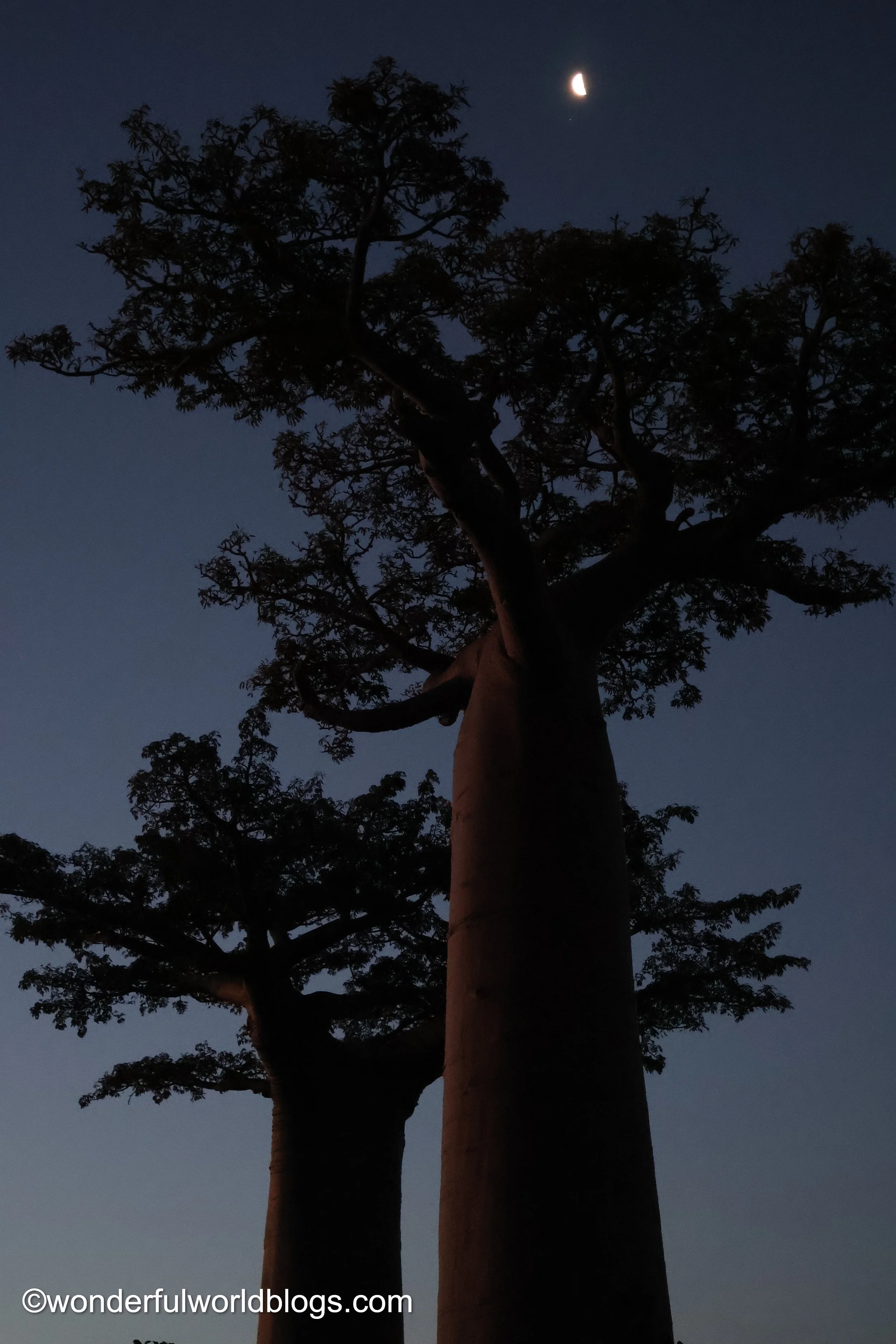
The baobab (reniala in Malagasy), the Tree of Life, or Mother of the Forest, can live up to 3,000 years and reach thirty metres in height. The largest (up the coast from where I was, but unreachable at this time of year due to flooding) has a circumference of twenty-nine metres. They are sometimes hollowed out and used as wells. Their name “Tsitakakanesa” means "if you sing on one side you cannot hear it on the other." According to legend god made the baobab so beautiful that the devil got jealous, lifted it up and replanted it upside down so he could see it from hell!
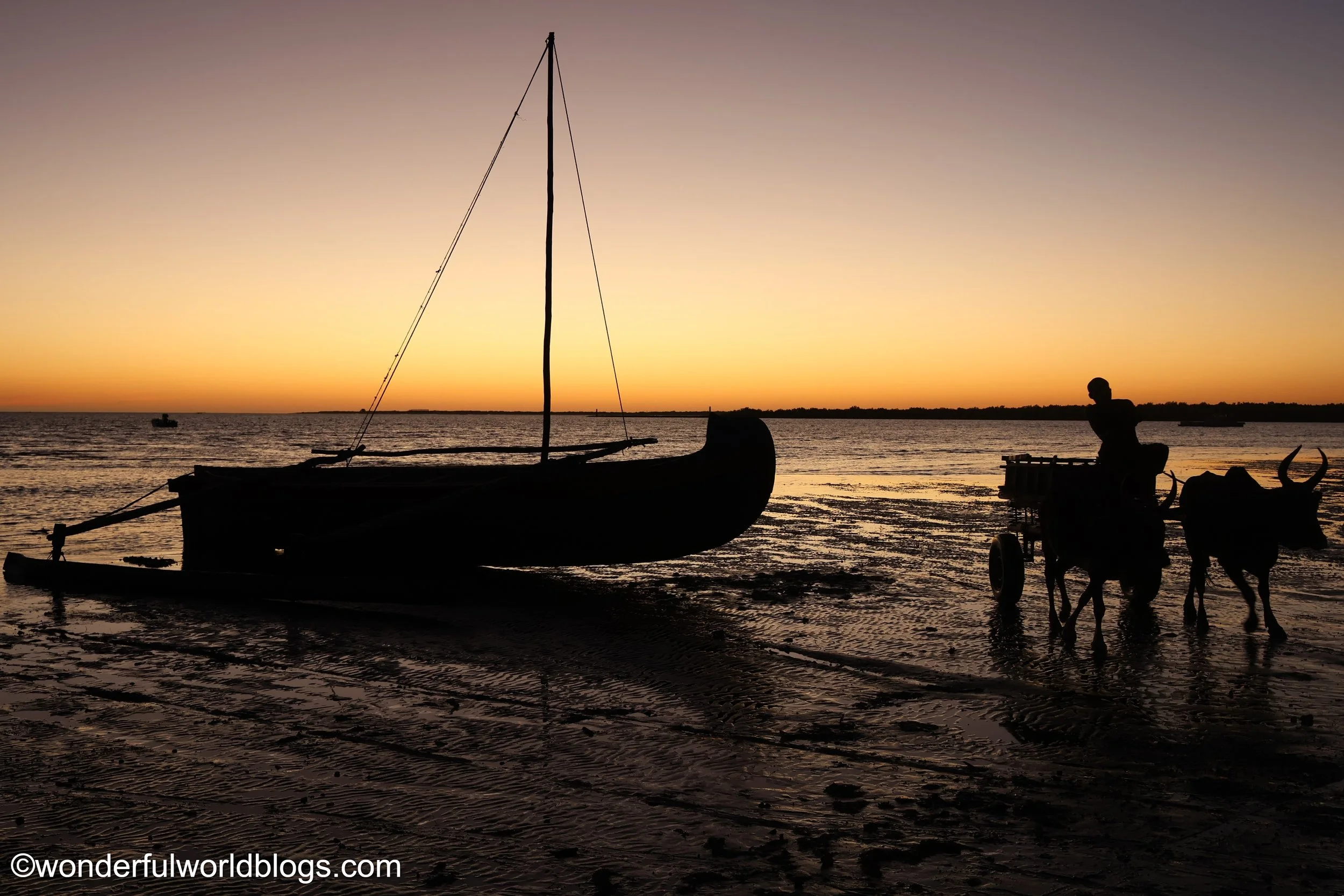
The gateway to the south-western coastal region is the lively port town of Toliara. There rickshaw drivers fight for your attention while off-shore lies the Great Reef, at 450 kilometres the fifth largest in the world. As the sun set zebu drivers rode their carts down the beach and out into the water. Meanwhile a colourfully-dressed group of Christians gathered to sing and pray in the warm evening air.
Anakao
Disappointingly an open trailer pulled by a tractor rather than a zebu cart took our expectant group of travellers down the beach to the awaiting Anakao Express. The journey down the coast is not far but one hour by motorboat would have taken seven on land with the difficult sandy 'roads' and the risk of ambush by bandits. Out on the water all the vessels apart from ours were either single-outrigger dug-out canoes (pirogues) propelled by bare chested men, or the same with a sail attached (a sturdy ocean-going design used as far away as Polynesia, which carried the Malagasy's ancestors here long ago).
Where the glistening sea met the shoreline a white sandy beach awaited, ready to caress bare feet with warm water and soft sand. At the top I entered the hotel through an arch made of the jaws of a huge whale. On either side stood the wooden shacks of Vezo fishermen, their multi-coloured pirogues pulled up in front, their children frolicking about in the tropical seas.
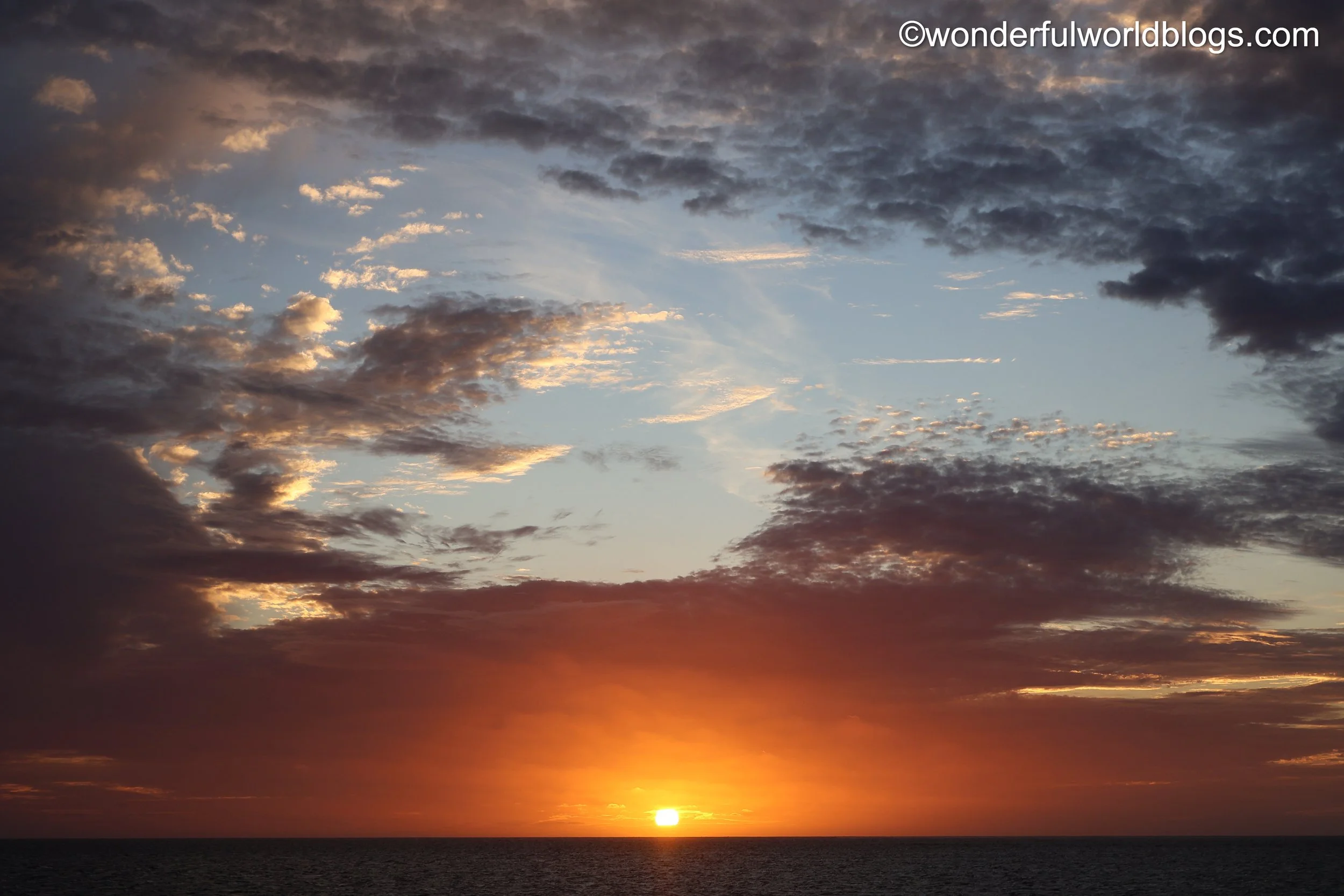
Walking up the beach that afternoon, on sand mercifully free of plastic pollution, I reached a secluded cemetery on a rocky headland and lingered a while to catch a sunset of god's finest watercolours. Returning to Anakao all was peaceful, the last few fishing vessels sailing home under the bright stars. Then, incongruously, the unbelievably loud sound of a lone electric guitar began wailing out across the village. "You won't sleep much tonight", a fisherman told me. "And don't complain, as the music is for those who have passed recently and will go on for three nights."
Nosy Ve
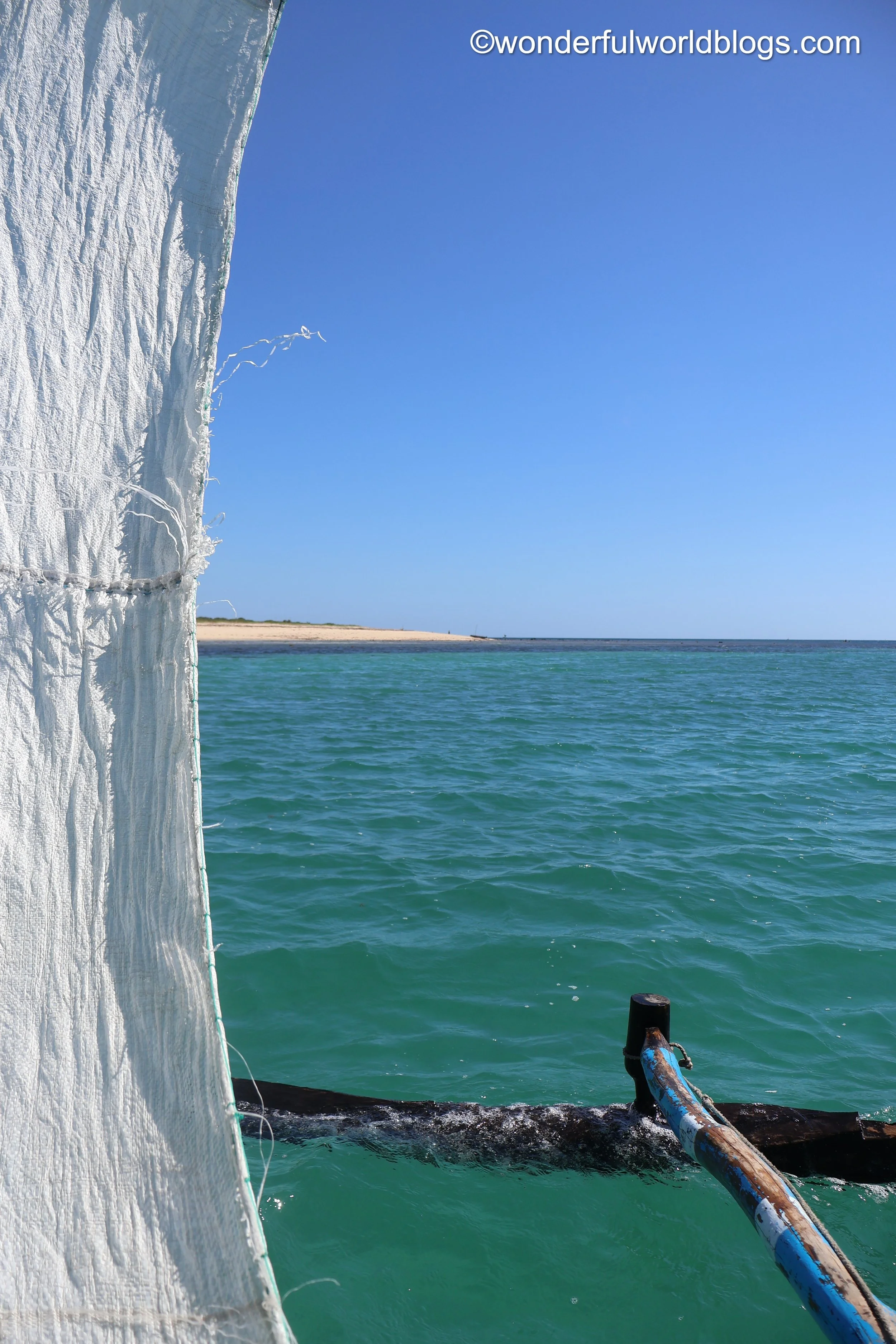
Up the coast is the village of St Augustine. Founded in 1645 it was the site of the first English settlement in Madagascar. Later it became a haven for pirates and provided inspiration for the writer Daniel Defoe, the author of Robinson Crusoe. But my destination was within sight of Anakao, the small island of Nosy Ve. Waiting for me was my fisherman friend from the day before and his chef, who doubled as the first mate. With a favourable breeze the pirogue was soon cutting through the water with ease. Wading ashore through waves breaking on a coral reef I stepped foot on a sublime sandy beach and set off to explore the interior. The small island is on the route of migrating birds, whales and dolphins, and was inhabited by adventurous Bourbon traders in the 17th century, some of whom still rest in the overgrown cemetery. After lunch of a huge fish grilled on a rough fire, the sail doubling as a picnic blanket, the crew were in a hurry to leave as the wind was picking up. The calm straight of earlier had now metamorphosed into a veritable roller-coaster ride. But with the chef gamely riding on the outrigger to help balance the boat, his feet dangling in the waves, the ancient vessel in expert hands rode the lively waters easily but exhilaratingly back to the mainland.
Ambolimailaka
A few hours up the coast from Anakao is the fishing village of Ambolimailaka. An array of pirogues were pulled up on the beach in front of a jumble of wooden shacks separated by stick fences. A reluctant Pied Piper I quickly attracted a crowd of young children, for whom as the only foreigner and white person I was clearly a bit of a novelty. With my young entourage I found a shop frying dumplings for lunch, which I managed to scoff myself despite the profusion of hungry little eyes. I was not so lucky with the packets of biscuits I purchased which disappeared in record time without me tasting so much as a crumb.
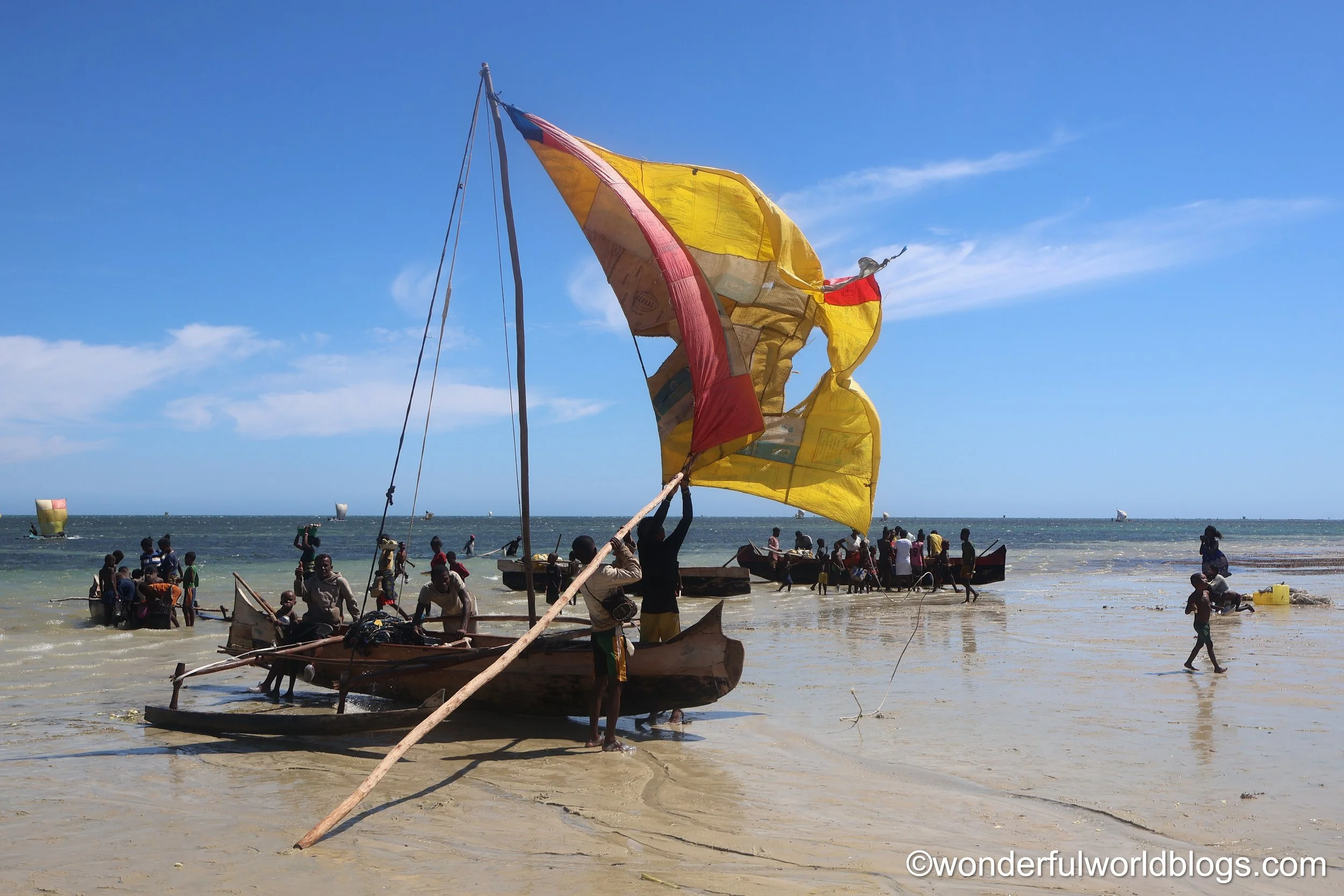
Returning to the beach with a smaller posse of friends, the rest having got what they wanted, the children entertained me by digging up tiny crabs from the wet sand, until I saw an array of sails fast approaching, the sight for which Ambolimailaka is famous. The women and children hurried to the shore with expectant buckets, the men, in a show of bravado, approached fast and only lowered their sails moments before hitting the sand. A crowd gathered around each boat and divided up the catch, new streams of sails constantly appearing on the horizon. It was a scene that could have been witnessed in fishing communities around the world centuries ago - a fleet powered purely by sail using only hand-made nets and equipment. That night from my hotel on the hill above the village there were few electric lights to be seen (although apparently a lot of the adults do own a mobile phone, and manage to charge it somehow).
On the road back to Toliara I stopped off at Mangily village to visit a protected portion of spiny forest, 95% of which is unique to Madagascar. There I found an impressive assortment of baobabs, including some that were a thousand years old and others with broad, beer-bottle shaped trunks that provide a store of water during the frequent droughts. There were also Octopus Trees, Compass Trees (the branches always face south) and plants known to boost male sexual performance (even, I was told, for hundred-year-olds).
©wonderfulworldblogs.com
The Long Road (& Paddle) to L’Allée des Baobabs
A thirty-two-hour, three-day drive from the arid south-west via Antsirabe in the geographical centre and then out west again to the coast is a long way to go to see some trees. But the Allée des Baobabs has become the iconic destination in Madagascar, and I had just enough time to get there and enjoy a couple of days paddling down a river on the way, so my decision was made.
I woke to a gentle breeze through the mosquito net, the sounds of tropical birds and the distant prayer of "Allahu Akbar", and set off from Toliara on a creaky pousse-pousse (rickshaw), before transferring to the soon-to-be-familiar front seat of a 4x4...
...through dusty streets, across arid plains, over sandstone mountains where the Bara bury their dead. Traversing a high plateau, giving way to plunging valleys, the temperature dropped, the greens deepened and the oh-so-familiar rice paddies began to appear again. Corn-on-the-cob and eggs for sale, a pig butchered by the roadside, but always hungry children calling out as you pass. A lone zebu dawdling along a dry riverbed, a crowd gathered around a thatched cottage, its roof on fire, as dusk fell. A flamingo sunset then magical stars in the darkness, broken only by the anonymous glare of on-coming traffic. On through dark forests and black streets, your passing acknowledged only by barking dogs...
...Five hours' sleep, then awoken by a cockerel and a few cups of dark Malagasy coffee. Off again along spaghetti roads climbing through sweeping mountain landscapes, more zebu carts than cars, then once again chasing the setting sun.
A few weeks ago I had travelled from Antsirabe to Toliara by the baking sea. Now rewinding I saw familiar views again with pleasure. All too frequently though the car would grind to a virtual halt, slowing to avoid suspension-wrecking potholes, doubling or trebling the length of the journey.
On the third day heading out west again past Miandrivazo with the temperature climbing, the car broke down in deep sand. My companions and I got out to push and managed to bring our hard-working steed back to life. Then suddenly the longest drive of my life was over. A shallow, reedy stream heralding the start of several days' journey by pirogue.
Paddling down a peaceful tributary of the mighty Tsiribihina River, passing families fishing, bathing or doing their laundry, was a relief after days of noise and shaking in a 4x4. As a precaution I decided to Google "What to do if you encounter an angry crocodile?" "Back away slowly, don't approach or attempt to take a selfie, don't feed it a sandwich, or your leg." Someone had even asked "What should I do if I am caught in a crocodile's jaws under water?", and requested a prompt answer: "As a last resort, poke its eyes."

If you are enjoying WWB
please Buy me a coffee
by clicking on the image above.
This will help fund the website
& future projects.
Thanks for your support!
Matthew
The Tsiribihina River
In the rainy season the Tsiribihina and her tributaries can be up to four metres higher than when I visited, and periodically we ground to a halt on the sandy river bed and had to wade through the warm water. Passing through a curtain of overhanging reeds rustling in the breeze we entered the wide expanse of the main river a hundred metres or more across, fortunately relatively calm apart from the occasional whirlpool.
For the most part boats and fire are not a good combination. But our guide, who doubled as a chef, had spent the morning peeling vegetables and as lunchtime approached a welcome aroma passed along the boat from a small pot atop a charcoal fire. We pulled up on a sandbank and ate under the welcome shade of an overhanging tree. As if out of nowhere several pirogues suddenly appeared and a large Sakalava family jumped out and joined us for lunch. We shared our food and I produced some rum that I had brought along for just such an occasion.
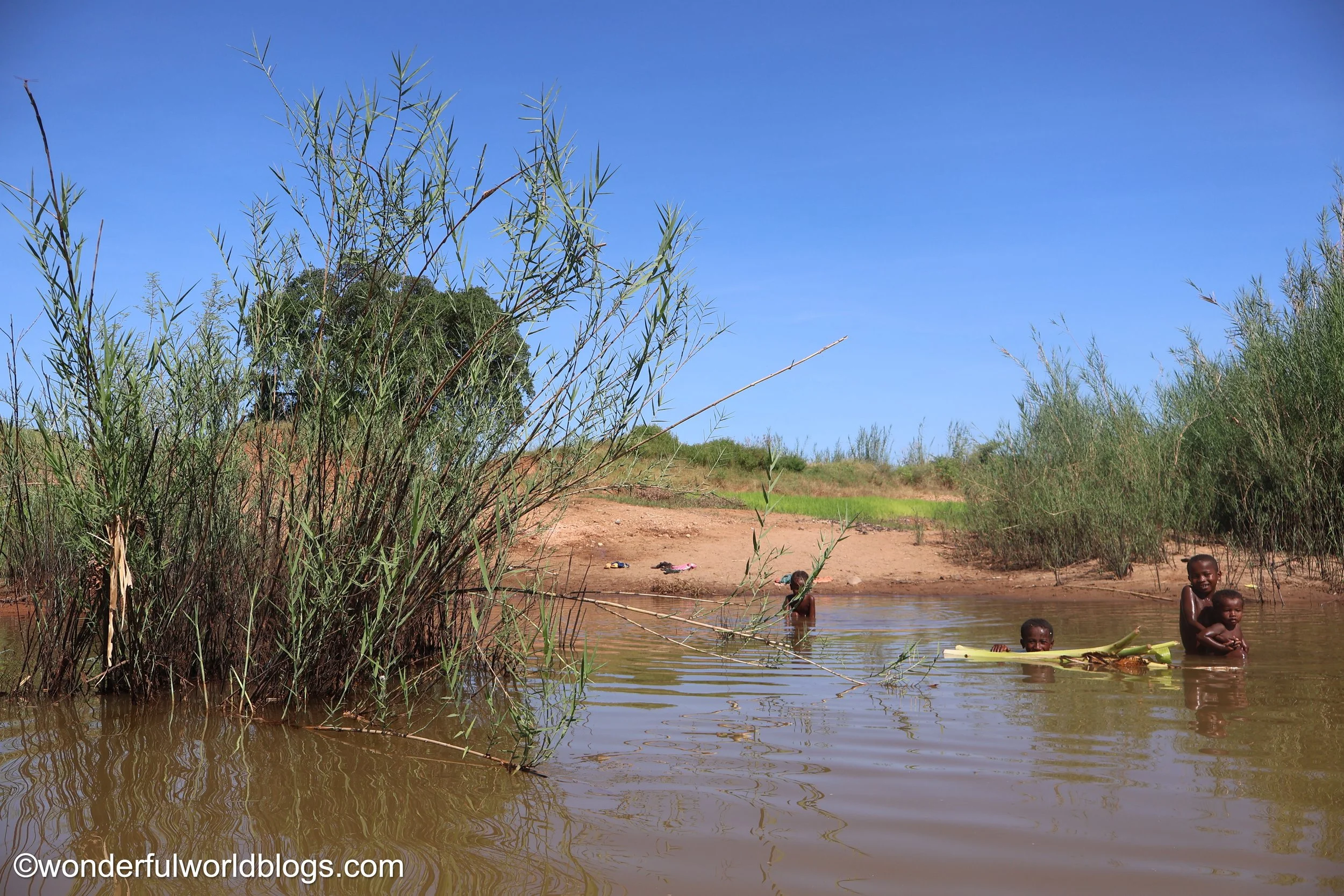
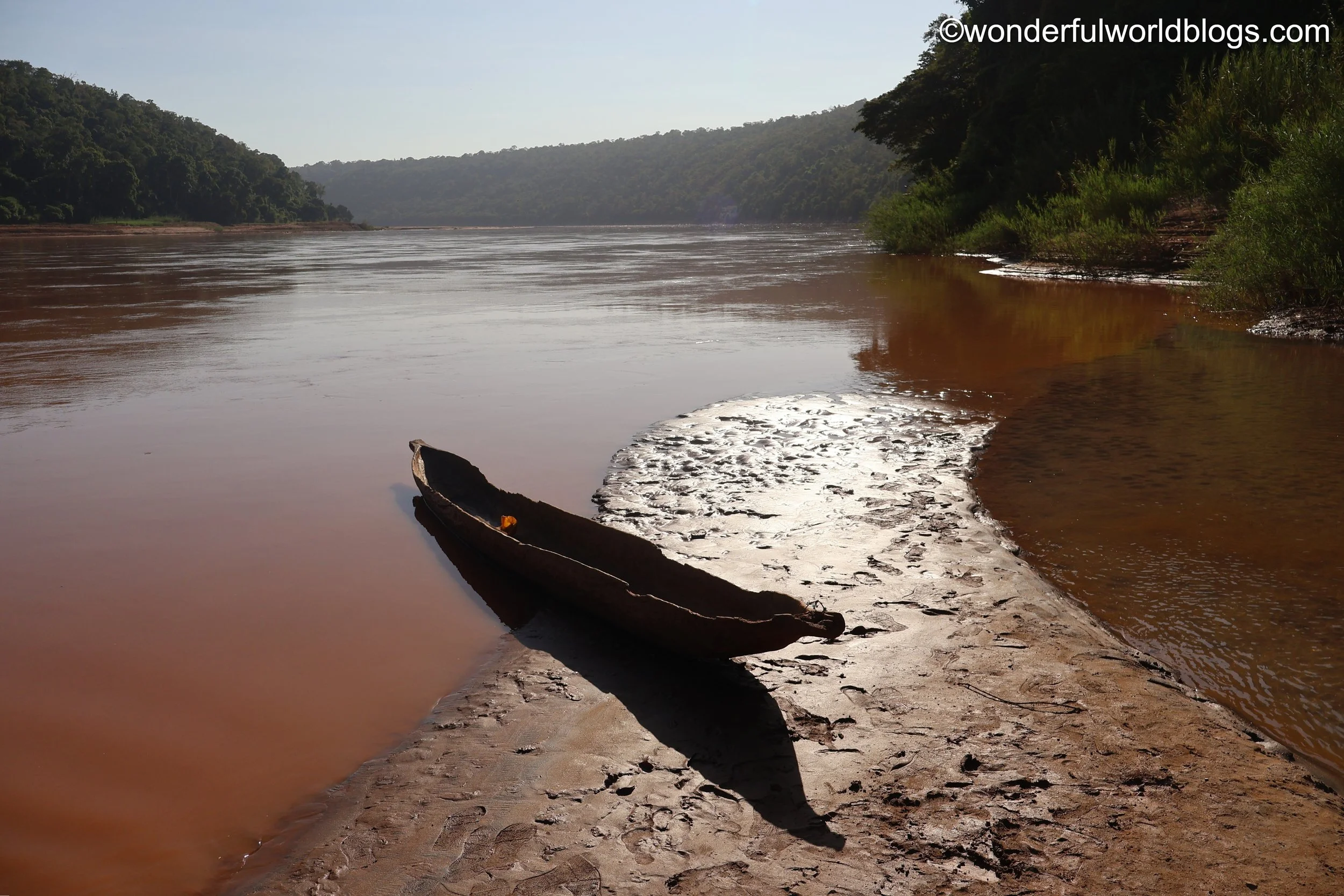
The Sakalava live on, in and by the river in wooden huts, unchanged through the centuries. Passing through a deep gorge their cries rose up out of the jungle duetting with the sounds of tropical birds. Gliding along in the cucumber-scented air, feeling the flow of the chocolate-coloured water in your hands, escaping from the sun under an umbrella like some genteel missionary of times past, was to live at a different pace. That night we pulled up the pirogue on the bank and bathed in a cool blue pool under a dreamy waterfall, returning to eat by the light of a fire under the starry sky.
The next day we visited a small village. A crowd of expectant children quickly gathered around us while the adults kept busy with their chores, beating rice with heavy sticks or preparing corn. One bare-chested old man remained in the shade puffing on weed, acting as though we were merely some figment of his imagination. As our guide pointed out, "There is no Wifi here, so after dark there is only one activity available to adults, which explains the large number of children". Theirs is a simple life, but they certainly looked contented.
Our peaceful few days away from the worries of the world abruptly came to an end as we regained mobile signal and pulled up the pirogue for the last time. We thanked the boatman and loaded up the awaiting 4x4, the only disappointment being not having seen any crocodiles.
L’Allée des Baobabs
After a few hours bouncing in and out of potholes like a speedboat on a rough sea the 4x4 pulled up at a tea stall in the shade of a tree. There it was time to say farewell to Max the guide, to Murphy a globetrotting grandfather and to Yeni, a Honduran hairdresser. Climbing into a new vehicle my driver Bonne Chance and I set off once again. We were baobab-bound.
First came the Forest of Baobabs, a meeting of elder statesmen standing proudly above the arid plain, as a zebu cart passed by. Next in a quiet copse by a rural bus stop stood the biggest tree I had seen in my life, the Sacred Baobab, 3,000 years old or more. You would need a football team holding hands to reach around her circumference. She gave off an aura of calm and timeless wisdom. Then the Baobab Amoureux (Baobab in Love), its twin trunks twisted around each other like Rodin's Kiss. And finally, L’Allée.
A nondescript dirt track, twenty kilometres outside Morondava, en route to Belo-sur-Tsiribihina. After what I had seen in the rest of the country at first I had a feeling of disappointment, partly due to the presence of the tacky tourist stalls and a bus park situated nearby. The giant trees peered down at the groups of expectant tourists with a quizzical eye, keeping their distance from each other like rush-hour commuters on the London underground. It was only later as the sun set that from the right angle the baobabs suddenly arranged themselves into an image that people will travel half way around the world to see. And yet it was not the image that I had previously imagined - one of natural wonder in a pristine environment. The baobabs themselves were majestic alright, but looking around I could see they stood isolated amidst a sea of deforestation. The contrast with the trees in the spiny forest in Mangily, surrounded by rich vegetation as they should be, could not have been more pronounced. Madagascar - wild, magnificent, unique and timeless as she may be - is threatened now as never before.
On my last night the rain fell for the first time since I had arrived. Early the next morning the bus set out on the long bumpy road back to Antananarivo as families cooked their breakfast over little fires and the sun rose over the hills of Madagascar.
©wonderfulworldblogs.com